

Exploring the Intersection of History and Geopolitics
History and geopolitics are not simply records of past events; they are the study of how power is organised, contested, and preserved over time. At Global Chessboard, this section approaches global affairs through a structural lens, examining the incentives, institutions, and strategic calculations that shape state behaviour. Wars, alliances, intelligence operations, economic leverage, and diplomatic doctrine rarely emerge in isolation. They are responses to deeper pressures embedded within the international system.
Rather than focusing on headlines or momentary crises, this category explores the underlying architecture that sustains global order. Political decisions are often framed publicly in moral or ideological terms, yet beneath those narratives lie calculations of security, influence, and survival. Understanding geopolitics requires examining both the visible outcomes and the hidden mechanisms that produce them.
The modern world remains deeply influenced by historical turning points. Institutions formed after major conflicts, doctrines shaped during periods of strategic rivalry, and power structures designed to prevent escalation continue to affect contemporary policy. Many present-day tensions are not new phenomena but extensions of unresolved structural dynamics.
This section emphasises analytical clarity over commentary. It evaluates how states justify action, how institutions function under pressure, and how long-term strategy frequently outweighs short-term rhetoric. By situating current developments within their historical context, the goal is to provide a disciplined interpretation rather than a reaction.
Geopolitics is ultimately the study of organised power in motion. To understand it is to recognise that the present is shaped by accumulated decisions, layered incentives, and enduring institutional design.
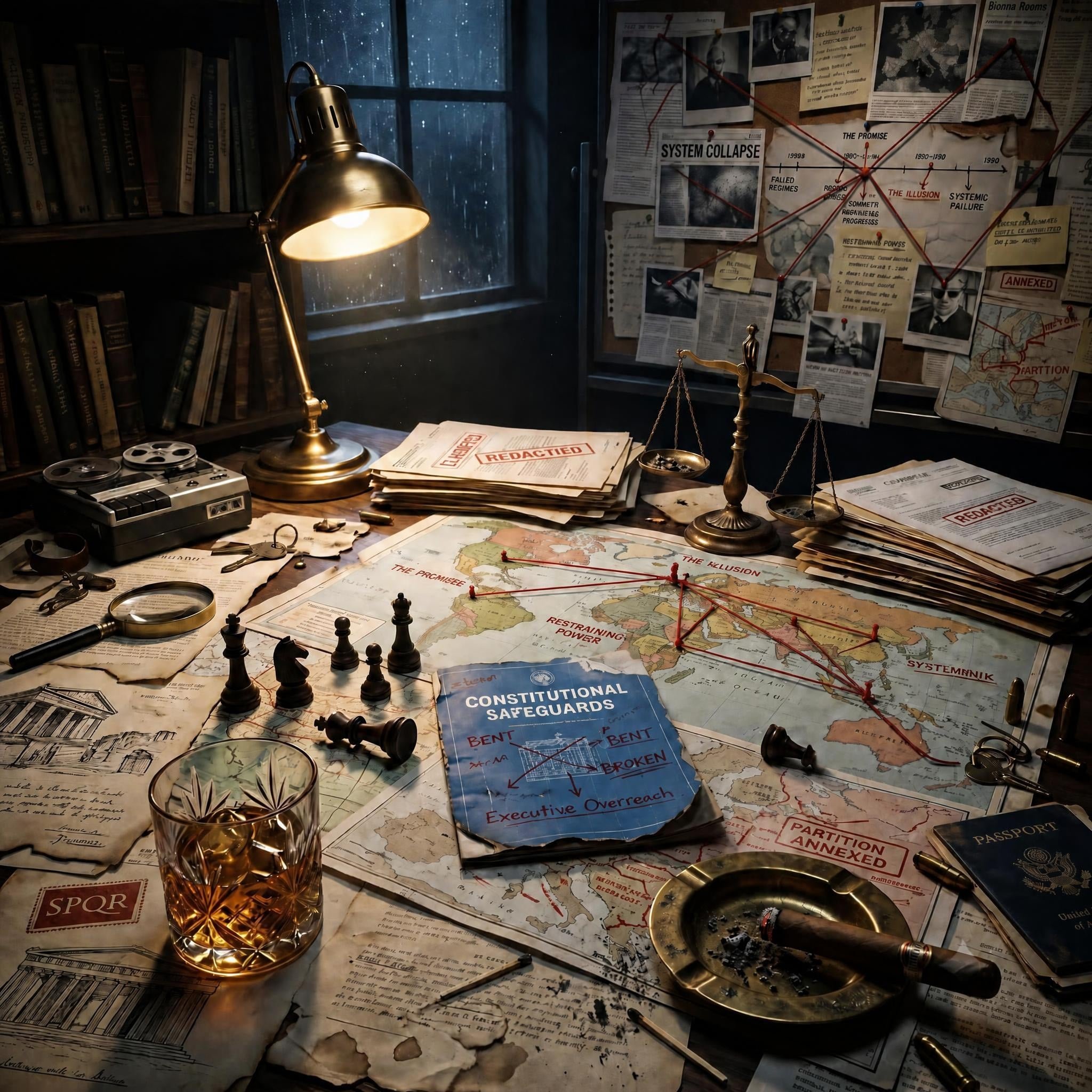
The Illusion of Governance: How Political Systems Are Built, Bent, and Broken.
Every political system begins with the same question: who should hold power, and what should stop them from abusing it?
Democracy gave authority to citizens, republicanism divided it, constitutions attempted to restrain it, communism promised to redistribute it, fascism concentrated it, and emergency government temporarily expanded it.
History complicated every answer. Governments learned to bend constitutions without abolishing them, armies learned to rule without always removing civilians, elections survived inside systems where political competition weakened, and democracies themselves sometimes suspended the rights they were built to protect. The Illusion of Governance follows the ideas, institutions, and historical crises that reveal the gap between what a political system is called and how power actually operates within it.