Henry Kissinger and The Noble War Prize: The Countries That Paid For Peace.
Late-twentieth-century diplomacy presents a notable paradox: a celebrated public image of peacemaking coexisted with a concealed archival record of geopolitical maneuvering. For more than fifty years, Henry Alfred Kissinger symbolized diplomatic statecraft, global equilibrium, and intellectual authority. Publicly, he was recognized as a Harvard academic who rose to the highest ranks of American foreign policy, serving as National Security Advisor and Secretary of State under Presidents Richard Nixon and Gerald Ford. Kissinger was credited as the architect of détente with the Soviet Union, the strategist behind the opening to the People’s Republic of China, and the principal negotiator of the Paris Peace Accords that enabled the American military withdrawal from Vietnam. These achievements culminated in his receipt of the 1973 Nobel Peace Prize, reinforcing his reputation as a leading diplomat. However, beneath this public acclaim lay a concealed record. Over several decades, a gradual process of declassification—driven by Freedom of Information Act litigation, congressional investigations, and the release of thousands of secret telephone transcripts and presidential recordings—revealed a more troubling dimension of his statecraft. The documentary evidence exposed strategic decisions that treated human lives and democratic institutions in smaller regional states as instruments for achieving great-power stability. In Cambodia, East Pakistan, Chile, and East Timor, the human consequences of realpolitik became apparent. For historians and political scientists, the central issue regarding Kissinger is not merely a moral debate between war crimes and diplomatic accomplishments. Rather, it presents an analytical and systemic question: how did Kissinger’s reputation as a distinguished peacemaker and authority on international order persist despite the exposure of this troubling documentary record? A comprehensive understanding of Kissinger requires analyzing his statecraft within a broader network of independent actors—including American presidents, competing cabinet officials, intelligence agencies, and foreign leaders—who operated under a shared, inflexible logic of power.
A critical examination of Kissinger’s enduring intellectual authority necessitates analyzing the deliberate construction of his reputation. Unlike the traditional elite of the mid-twentieth-century foreign policy establishment, Kissinger was an outsider, having fled Nazi Germany as a German-Jewish refugee in 1938. He advanced through the meritocratic structures of the so-called "Cold War University," leveraging his intellectual acumen to become a prominent defense intellectual. His academic reputation was established with his doctoral dissertation, A World Restored: Metternich, Castlereagh and the Problems of Peace, 1812–1822, which examined the post-Napoleonic European balance of power. In this work, he introduced the concept of "legitimacy," distinguishing it from justice and defining it as a consensus on the rules of international order and an equilibrium of forces accepted by all major powers. Within this Primat der Außenpolitik (primacy of foreign policy) framework, public opinion and morality were considered irrelevant to the primary goal of maintaining the international system. Upon his appointment as National Security Advisor in 1969, the United States was deeply engaged in the Vietnam War and experiencing significant domestic political polarization. Kissinger bypassed the traditional State Department bureaucracy by employing highly secretive "backchannel" communications, primarily with Soviet Ambassador Anatoly Dobrynin and Chinese Premier Zhou Enlai. This centralized and personalized approach to statecraft produced several major geopolitical achievements, including the 1971 opening to China, the 1972 Strategic Arms Limitation Treaty (SALT I) with the Soviet Union, and the post-1973 "shuttle diplomacy" that facilitated troop disengagements in the Middle East.
The negotiation of the Paris Peace Accords in January 1973 marked the political apex of Kissinger’s great-power diplomacy. Alongside his North Vietnamese counterpart, Le Duc Tho, Kissinger crafted an agreement that enabled the complete withdrawal of American combat forces in exchange for the return of prisoners of war. On October 16, 1973, the Norwegian Nobel Committee announced that the Nobel Peace Prize would be awarded jointly to Kissinger and Tho, a decision that immediately provoked significant controversy and initiated the so-called "Nobel War Prize" debate. Two committee members resigned in protest, an unprecedented event in the award’s history. Critics noted that the ceasefire was already collapsing and that the accords were negotiated with the expectation that the conflict would continue. Declassified Nobel Committee files, released fifty years later, confirm that the panel was aware the accords were unlikely to secure lasting peace, yet Sanness argued that the decision would highlight the positive development of the United States' formal withdrawal. Le Duc Tho declined the award, citing ongoing violations of the Paris Agreement and the absence of genuine peace in South Vietnam. Kissinger accepted the prize but declined to attend the ceremony, citing scheduling conflicts, and later attempted to return the medal after the fall of Saigon in 1975, though the committee refused. Despite the immediate controversy, the prize permanently institutionalized Kissinger’s status as a global authority on peace, enabling him to maintain influence after the collapse of the Nixon presidency.
A comprehensive understanding of the controversial aspects of Kissinger’s statecraft necessitates examining his underlying philosophy of power, which was rooted in a fundamentally tragic view of history and human nature. This perspective sharply contrasted with traditional American Wilsonian idealism, which prioritized moral values, international law, and the promotion of democracy. For Kissinger, such moralism was a dangerous indulgence that often led to ideological crusades, instability, and, in the nuclear era, the risk of global catastrophe. His realist approach accepted the international system as inherently anarchic, composed of sovereign states pursuing their own national interests. Within this framework, stability was considered the highest moral imperative. Kissinger frequently paraphrased Goethe: "If I had to choose between justice and disorder, on the one hand, and injustice and order, on the other, I would always choose the latter." In his ethical framework, order was a prerequisite for any form of justice; without a stable international equilibrium, aspirations for liberty were considered illusory. His statecraft was guided by the principle of "linkage," which asserted that events in disparate regions were fundamentally interconnected. Local crises were evaluated not only for their regional implications but also for their potential to affect the strategic balance among Washington, Moscow, and Beijing. Within this tragic philosophy, regional crises and localized atrocities were regarded not as systemic failures, but as the regrettable, unavoidable "transactional costs" of maintaining a stable global great-power equilibrium.
A frequent historical oversimplification depicts Kissinger as a solitary, omnipotent figure orchestrating global events in isolation. In reality, his policies were implemented within a complex and competitive network of independent actors, both domestic and international, each pursuing their own agendas that Kissinger had to manage, influence, or accommodate. Richard Nixon retained ultimate executive authority, making final decisions regarding the use of force, such as the invasion of Cambodia and the extensive bombing of North Vietnam. The relationship between Nixon and Kissinger was highly collaborative yet deeply dysfunctional, characterized by mutual dependence, intense bureaucratic rivalry, and Nixon’s pronounced jealousy of Kissinger’s public prominence.
Following Nixon’s resignation, Gerald Ford assumed the presidency and granted his Secretary of State considerable autonomy in conducting global diplomacy, shielding him from domestic political criticism. Kissinger’s rise was marked by an intense, covert bureaucratic struggle against Secretary of State William Rogers and Secretary of Defense Melvin Laird. Rogers was systematically excluded from major geostrategic initiatives, and Kissinger frequently classified key documents to prevent Rogers from accessing them, thereby establishing a parallel national security structure that rendered the State Department’s formal bureaucracy obsolete. Laird, in contrast, opposed the falsification of military coordinates and the secrecy surrounding the Cambodian bombings, insisting that the administration defend its policies legally and publicly before Congress. Foreign dictators and negotiators were not passive actors; rather, they were highly rational and independent, adept at exploiting U.S. Cold War anxieties and geostrategic priorities to advance their own regional ambitions. General Yahya Khan of Pakistan leveraged his role as the secret channel to Beijing in 1971 to shield his regime from U.S. interference during a brutal crackdown in East Pakistan. General Augusto Pinochet in Chile exploited the Nixon administration's determination to prevent a "second Cuba" by using U.S.-backed support to establish a 17-year dictatorship, presenting his regime as a bulwark against communist subversion. President Suharto of Indonesia positioned his country as the essential anti-communist anchor of Southeast Asia, thereby securing Washington’s tacit approval for the annexation of East Timor. Le Duc Tho, a resolute negotiator, viewed negotiations as a tactical effort to exhaust American resolve while maintaining North Vietnam’s objective of national unification under communist rule.
The central historical tension in Kissinger’s legacy lies in the stark contrast between his polished public narrative and the unvarnished reality preserved in classified archives. Beginning in the early 2000s, a "declassification revolution"—driven by archivists, investigative journalists, and historical litigation—unlocked a vast paper trail of once-top-secret documents, cables, and transcripts. In Southeast Asia, declassified materials revealed the depth of deception in his statecraft, starting with Operation Menu, a massive carpet-bombing campaign by B-52 bombers inside neutral Cambodia in March 1969. Fearing a domestic anti-war backlash, Nixon and Kissinger devised a "dual reporting system" that systematically falsified military radar and target records, dropping over 100,000 tons of bombs on Cambodia while keeping Congress and the public uninformed. When the secret was exposed in 1973, Kissinger claimed the secrecy was necessary to protect Prince Sihanouk’s diplomatic position, a claim contradicted by declassified records. Additionally, declassified materials revealed the cynicism of the "decent interval" strategy, showing that Kissinger’s primary concern in the Paris Peace negotiations of 1972 was not a durable peace, but rather securing a "decent interval" of a few years between the U.S. military withdrawal and the collapse of the South Vietnamese government. The South Vietnamese allies, led by President Nguyen Van Thieu, were systematically kept uninformed about major concessions, including the unilateral decision to allow North Vietnamese army divisions to remain in South Vietnam. When Thieu discovered the terms of the draft treaty in October 1972 and voiced his strong rejection, calling the agreement a form of "suicide," Kissinger attempted to pressure him into submission, ultimately resorting to a series of intense bombing raids on Hanoi—the 1972 Christmas Bombings—to force both North and South Vietnam back to the negotiating table.
In South Asia, declassified records exposed the severe human costs of Kissinger's triangular diplomacy during the 1971 Bangladesh genocide. In March 1971, the military dictatorship of West Pakistan, led by General Yahya Khan, launched Operation Searchlight, a brutal campaign to suppress the democratic mandate of the Awami League in East Pakistan, resulting in mass murder, rape, and forced expulsion that killed hundreds of thousands of Bengalis and forced ten million refugees to flee to India. At the consulate in Dacca, career diplomat Archer Blood and his staff meticulously documented the atrocities, sending a collectively signed cable over the State Department's official "Dissent Channel" on April 6, 1971—the "Blood Telegram"—directly accusing the U.S. government of "moral bankruptcy" for failing to denounce the ongoing genocide and continuing to provide military and economic aid to the Pakistani junta. White House tape recordings and telephone transcripts declassified decades later reveal the Nixon-Kissinger response to the dissent, with Kissinger telling the President that the Dacca consulate was in open rebellion and dismissing Blood as a "maniac" and a "bleeding [bleating] heart." Nixon ordered Kissinger to have Blood immediately fired and recalled to Washington, where his career was permanently derailed. Nixon and Kissinger maintained their support for Yahya Khan’s regime throughout the violence, secretly authorizing Jordan and Iran to transfer American military aircraft to West Pakistan, and ordering the aircraft carrier USS Enterprise to lead a task force into the Bay of Bengal when India intervened militarily. The declassified tapes also reveal the personal and racist dimensions of this policy, recording Kissinger referring to Indian Prime Minister Indira Gandhi as a "bitch" and subcontinent Indians as a "slippery, treacherous people," and showing that the geostrategic rationale for this policy—the necessity of keeping Yahya Khan’s secret channel to China open—was prioritized over human rights concerns, despite staff presenting alternative channels.
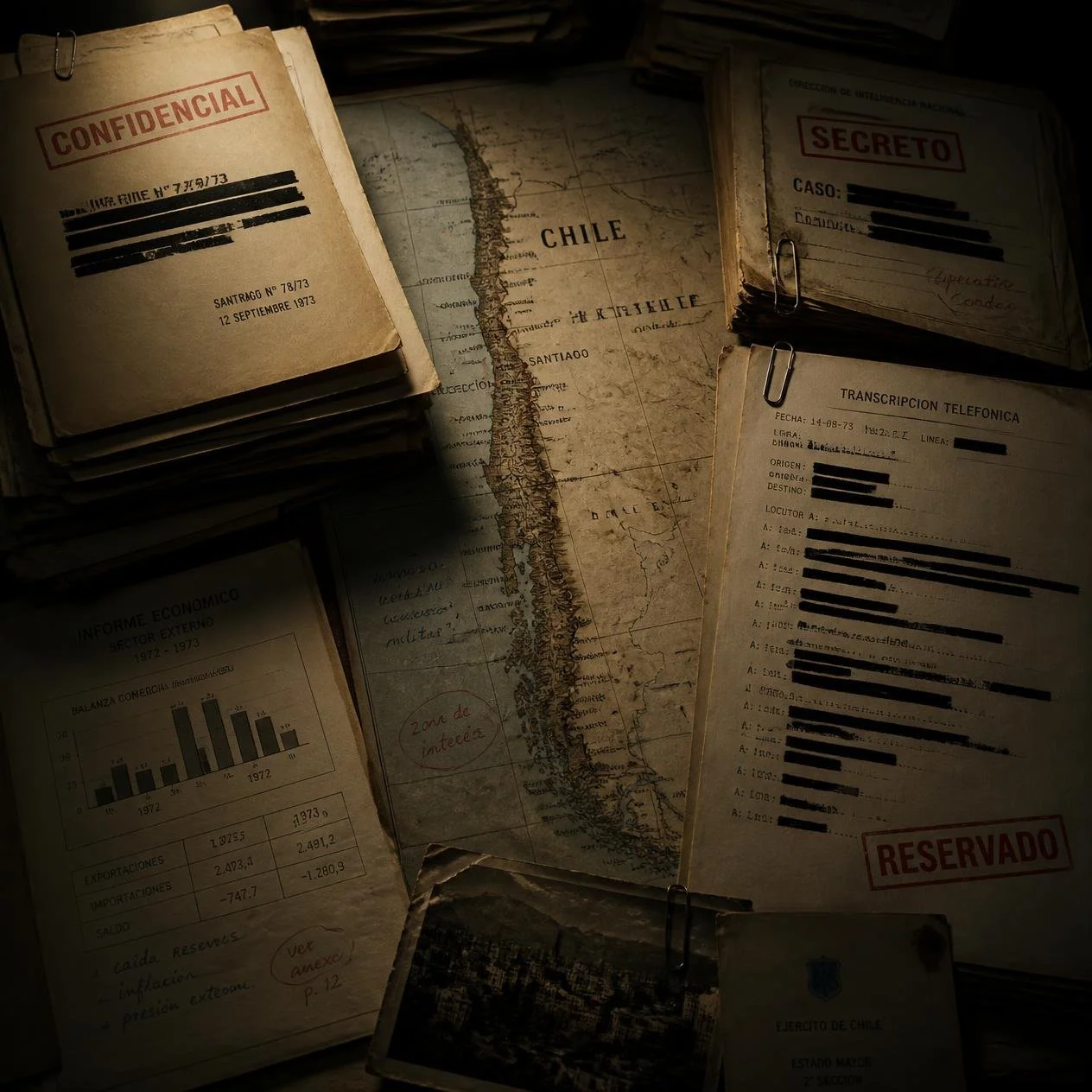
In Latin America, declassified records dismantled the public narrative of U.S. non-intervention in Chile. In September 1970, when Socialist Salvador Allende won a plurality in the Chilean presidential election, Nixon and Kissinger viewed his democratic victory as a significant threat to U.S. hegemony in the Western Hemisphere. Nixon summoned Kissinger and CIA Director Richard Helms to the Oval Office, issuing direct instructions to "make the economy scream" and organize a military coup to prevent Allende’s inauguration. The resulting covert operation, Project FUBELT, was managed directly from the White House by Kissinger and the CIA, focusing on inciting a military coup. To facilitate this, the CIA supplied submachine guns and funds to right-wing military conspirators plotting to kidnap the constitutionalist Commander-in-Chief of the Chilean armed forces, General René Schneider, who was subsequently assassinated. After Allende's election was ratified, Kissinger presented a secret, eight-page memorandum to Nixon outlining a long-term strategy of economic and political subversion to ensure Allende's eventual collapse, a campaign that culminated on September 11, 1973, in a violent military coup led by General Augusto Pinochet, resulting in Allende’s death and the destruction of Chilean democracy. In a declassified telephone call with Nixon five days after the coup, Kissinger celebrated Pinochet's victory, lamenting that they could not openly take credit as "heroes" for Allende's overthrow. Once Pinochet was in power, Kissinger actively supported his regime, famously writing on an official cable: "Tell Popper to cut out the political science lectures" when the U.S. Ambassador raised human rights abuses. This support extended to Operation Condor, a transnational network of Southern Cone military intelligence services organized to hunt down, kidnap, and assassinate political dissidents across borders. Declassified State Department documents show that on September 16, 1976, Kissinger, then traveling in Lusaka, Zambia, personally intervened to quash a written U.S. diplomatic warning ordering Condor regimes to halt international assassinations, just five days before Pinochet's secret police detonated a car bomb in Washington, D.C., assassinating Chilean diplomat Orlando Letelier and his American assistant, Ronni Moffitt.
Declassified archives also reveal U.S. approval of Indonesia’s invasion of East Timor. In December 1975, as Portuguese East Timor underwent decolonization and the left-wing Fretilin movement gained prominence, President Suharto prepared for a full-scale military invasion to annex the territory, relying heavily on U.S.-supplied military equipment that was legally restricted to defensive use. Declassified transcripts from a private meeting in Jakarta on December 6, 1975, indicate that when Suharto sought approval for "rapid or drastic action," President Ford expressed understanding, and Kissinger cautioned about the legal implications of using U.S.-manufactured weapons offensively, stating: "the use of U.S.-made arms could create problems... It depends on how we construe it: whether it is in self-defense or is a foreign operation." Kissinger further advised Suharto on the need for operational urgency, emphasizing, "It is important that whatever you do succeeds quickly," and requested that the invasion be delayed for 24 hours until the American delegation had returned to U.S. soil to better manage the response and minimize public scrutiny. Six months into the occupation, which resulted in the deaths of between 100,000 and 200,000 East Timorese civilians, Kissinger’s legal advisor, Walter Leigh, informed him that U.S. arms sales to Indonesia were technically illegal and required an embargo. Kissinger’s response was notably cynical: "Not very willingly. Illegally and beautifully."
This analysis returns to the central question: how did Kissinger's prestige persist despite the exposure of this troubling documentary record? While other prominent members of the Nixon administration faced disgrace, imprisonment, or exclusion from public life during the Watergate scandal, Kissinger remained legally unaffected and retained his reputation as Washington's leading authority on foreign affairs. His continued influence was sustained through a deliberate, multifaceted strategy that began with the founding of Kissinger Associates, Inc. in 1982. This highly profitable, confidential geopolitical consulting firm enabled him to maintain significant influence and financial independence by serving as a key intermediary between global corporate interests and foreign leaders.his career, Kissinger demonstrated mastery in public relations, employing his natural charm, wit, and calculated disclosures to cultivate close relationships with influential journalists, editors, and media executives. These relationships shielded him from critical investigative reporting and ensured his status as an exotic celebrity within Washington’s elite social circles. Upon leaving office, Kissinger focused on securing his historical legacy, producing three extensive volumes of memoirs—White House Years, Years of Upheaval, and Years of Renewal—which systematically obscured individual regional atrocities beneath extensive diplomatic details, administrative timelines, and geostrategic arguments. What he could not justify, he omitted, excluding East Timor from the indices of his memoirs and reducing the atrocities in East Pakistan to a tragic regional dispute. In the final decades of his life, he successfully reframed his historical legacy from "war crimes" to "controversies" of perspective, presenting himself as a tragic, misunderstood statesman who made difficult, dispassionate choices in an imperfect world. His defenders argued that his realist calculations, however callous in isolation, ultimately preserved global peace and prevented a catastrophic nuclear conflict between the superpowers, ensuring his status as a revered elder statesman until his death at the age of one hundred. Nevertheless, the declassified transcripts of his secretly recorded telephone conversations, eyes-only cables, and backchannel memoranda have created a final, indelible record of his statecraft, demonstrating that the countries that bore the cost for great-power peace—Cambodia, Bangladesh, Chile, East Timor—were not historical accidents, but systematic, structural consequences of an era when global order was prioritised over localised justice, and the human cost of stability was calculated in secret.
Oslo, 1973: The Nobel Peace Prize and the Paradox of Peace
On December 10, 1973, Oslo became the setting for a scene of profound irony. In the grand hall of the Nobel Institute, the award ceremony intended to commemorate the resolution of one of the twentieth century’s most devastating conflicts proceeded without either laureate present. The October 16, 1973 announcement that the Nobel Peace Prize would be jointly awarded to United States National Security Advisor Henry Kissinger and North Vietnamese Politburo member Lê Đức Thọ was met with immediate and widespread condemnation, both internationally and domestically. The New York Times labeled the decision the "Nobel War Prize," while satirist Tom Lehrer remarked that the selection had rendered political satire obsolete. Contemporary press coverage reflected prevailing cynicism, with headlines questioning whether the committee had merely awarded an "Honor without Peace?" The auditorium, typically a symbol of global moral consensus, was half-empty as the ceremony commenced. Outside, hundreds of demonstrators protested in the harsh Norwegian winter, perceiving the award as a validation of a military campaign characterized by unprecedented devastation. Rather than a celebration of peace, the event became a deeply controversial and politically charged occasion.
The formal rationale for awarding the prize was grounded in the Paris Peace Accords, signed on January 27, 1973, after years of arduous public and secret negotiations. The principal argument for recognizing these negotiations as a significant diplomatic achievement centers on the substantial geostrategic challenges that Kissinger navigated to secure an agreement. Facing intense domestic pressure, widespread anti-war protests, and declining troop morale, Kissinger implemented a multifaceted negotiation strategy. Central to this approach was triangular diplomacy: by initiating relations with the People’s Republic of China and achieving détente with the Soviet Union, the Nixon administration leveraged these relationships to pressure Hanoi’s allies and extract concessions from North Vietnam. The accords accomplished several key U.S. objectives: the complete withdrawal of American combat forces, the cessation of direct U.S. military involvement, and the repatriation of hundreds of American prisoners of war. From a realist perspective, the agreement preserved the sovereign government of South Vietnam under President Nguyễn Văn Thiệu, maintaining its military and police forces and rejecting Hanoi’s demand for a U.S.-imposed coalition government. Proponents of Kissinger regarded the accords as evidence of separating complex political disputes from immediate military concerns, providing South Vietnam with a temporary reprieve while enabling the United States to disengage from a divisive conflict.
However, this diplomatic narrative is contradicted by the realities on the ground in Vietnam. The ceasefire mandated by the Paris Peace Accords was largely ignored by both North and South Vietnamese forces almost immediately after its signing. Rather than ending hostilities, the accords initiated a new phase of intense localized combat as both sides sought to consolidate territorial control. Casualties remained high, with tens of thousands of South Vietnamese soldiers killed in the years following the supposed peace. The agreement’s character as a temporary truce rather than a lasting settlement was underscored by Lê Đức Thọ's actions. As a veteran revolutionary, Thọ refused to accept the prize, stating in a telegram to the Norwegian Nobel Committee that he could not accept a peace award while the United States and the Saigon government continued to violate the ceasefire. He indicated he would only consider accepting the honor once the Paris Agreement was fully respected, hostilities had ceased, and genuine peace was restored in South Vietnam. This refusal exposed the absence of true reconciliation and signaled that the conflict remained unresolved.
A thorough review of declassified negotiation records reveals a calculated strategy that contributed to the controversy surrounding the accords. The most consequential concession by Kissinger, which President Nguyễn Văn Thiệu described as "suicide," was the decision to permit North Vietnamese regular army divisions to remain in South Vietnam. While the United States completed its military withdrawal, approximately 140,000 to 200,000 North Vietnamese troops were allowed a legal and permanent presence in the South, resulting in a significant military imbalance. Declassified documents indicate that this was a deliberate decision by Kissinger as early as May 1971, concealed from South Vietnamese allies for over a year. This approach reflected the "decent interval" strategy, as Kissinger acknowledged in confidential memoranda: the objective was to create a period between American withdrawal and the anticipated collapse of South Vietnam, thereby preserving U.S. global credibility while abandoning its allies. Thiệu's government was excluded from the final drafting and compelled to sign the agreement under threats from Nixon to withdraw all economic and military support.
The Norwegian Nobel Committee was aware of these complexities, as revealed by the release of its confidential archives in 2023, fifty years after the award. Stein Tønnesson, a professor at the Peace Research Institute Oslo, observed that the committee recognized the Paris Peace Accords were unlikely to secure lasting peace in Indochina. The joint nomination of Kissinger and Thọ was submitted on January 29, 1973, just two days after the accords were signed, by John Sanness, a Norwegian academic and committee member. In his letter, Sanness acknowledged that the long-term significance of the accords was uncertain and would only become clear over time. Nevertheless, he argued that the prize was justified as it highlighted the positive outcome of ending direct armed conflict between North Vietnam and the United States. Declassified committee reports reveal internal tension: the panel was not honoring a genuine peace, but rather endorsing a strategic mechanism for U.S. withdrawal from an unpopular war. The selection process divided the committee, resulting in the unprecedented resignation of two of its five members in protest over the selection of Kissinger, who had been involved in controversial military strategies such as the secret bombing of Cambodia and the 1972 Christmas bombings of Hanoi.
Kissinger’s response to the announcement reflected ambivalence and a desire to avoid public attention. He informed the committee that he accepted the award "with humility" and donated his share of the prize money to a scholarship fund for children of American service members killed or missing in Indochina, but declined to travel to Oslo to accept the prize in person. Officially, Kissinger cited the demands of his new role as Secretary of State and a NATO foreign ministers' conference in Brussels as reasons for his absence. However, historical and psychological analyses suggest more complex motivations. Many observers believed Kissinger sought to avoid the large, hostile demonstrations anticipated in Oslo. Others noted his strained relationship with President Richard Nixon, who resented Kissinger receiving recognition for a policy Nixon considered his own, particularly as Nixon was embroiled in the Watergate scandal. Ultimately, Thomas Byrne, the United States Ambassador to Norway, delivered Kissinger’s brief acceptance speech to a subdued audience in a ceremony devoid of any sense of triumph.
The fragile appearance of stability established by the Paris Peace Accords ended on April 30, 1975, when North Vietnamese forces captured Saigon in a decisive offensive. The fall of the South Vietnamese capital was symbolized by the evacuation of diplomats and local allies by American helicopters from the U.S. Embassy rooftop. On May 1, 1975, the day after Saigon’s fall, Kissinger sent a cable to the Nobel Committee in Oslo, attempting to return the peace prize and his medal. In his message, he argued that the peace achieved through negotiations had been overturned by military force. The Norwegian Nobel Committee formally refused to accept the return, thereby solidifying the award’s reputation as one of the most controversial decisions in modern diplomatic history.
The 1973 Nobel Peace Prize remains a contentious issue in the history of statecraft and moral responsibility. It raises a central historical question: did the Oslo award recognize a genuine, albeit fragile, peace, or did it merely legitimize the management of a war that had not truly ended? Evidence from declassified archives and the subsequent fate of South Vietnam strongly supports the latter interpretation. According to the realist approach adopted by Kissinger and Thọ, the Paris Peace Accords were not intended to achieve lasting reconciliation in Vietnam. Instead, they functioned as a transactional arrangement, a "decent interval" presented as a formal treaty. For the United States, the accords provided a diplomatic means to resolve a domestic political crisis; for North Vietnam, they offered a strategic path to ultimate victory. By elevating this pragmatic compromise to the status of a global peace achievement, the Nobel Committee did not mark the end of conflict but rather established a precedent that allowed the human costs of war to be managed and obscured.
Cambodia and Laos, 1969-1973: Administrative Secrecy and the Covert Expansion of War
In early 1969, the Nixon administration confronted a military environment marked by both tactical urgency and strategic instability. Across the South Vietnamese border, within the officially neutral territories of Cambodia and Laos, the People’s Army of Vietnam and the Viet Cong had established fortified sanctuaries and base areas. These border regions, including the "Fishhook" and "Parrot's Beak," served as essential supply depots, training camps, and launch sites for offensives that resulted in substantial American casualties each week in South Vietnam. The Joint Chiefs of Staff consistently advocated for bombing these sanctuaries, arguing that success in a guerrilla war was unattainable while the enemy maintained protected bases just beyond the border. Militarily, targeting these areas was viewed as a necessary defensive action to disrupt North Vietnamese logistics, protect withdrawing American forces under the "Vietnamization" program, and eliminate the Central Office for South Vietnam (COSVN), believed to be the command center of the communist insurgency. When President Richard Nixon and National Security Advisor Henry Kissinger authorized the bombing, they simultaneously launched a comprehensive campaign of administrative deception, making secrecy a central component of war policy.
The strategic rationale for the air campaign—delaying North Vietnamese advances to strengthen the South Vietnamese army and pressuring Hanoi to negotiate—stood in stark contrast to the constitutional subterfuge used to conceal the operation. Nixon and Kissinger insisted that "absolute secrecy" was essential to avoid severe domestic political consequences. Nixon’s electoral mandate centered on reducing American involvement in the war, and any overt expansion into neutral territory threatened to erode remaining public support. The United States Constitution grants Congress the authority to declare war and allocate funds, and the administration acknowledged that Congress would not authorize military action against a neutral state. To circumvent this, Kissinger later advanced the "Sihanouk excuse," claiming that Prince Norodom Sihanouk of Cambodia had tacitly "acquiesced" to the bombings to expel Vietnamese forces. However, declassified documents reveal that Sihanouk was neither formally consulted nor did he approve a prolonged B-52 bombing campaign, and he repeatedly protested American incursions at the United Nations. Additionally, while Kissinger informed the Senate Foreign Relations Committee that the targeted border areas were "unpopulated," internal Joint Chiefs of Staff documents indicated that thousands of Cambodian civilians lived in these zones, including 1,640 civilians in Base Area 353 (Breakfast) and 770 in Base Area 352 (Dinner), a humanitarian concern the administration disregarded.
The operational framework for this deception was established on February 24, 1969, aboard Air Force One at Brussels Airport. During this meeting, Kissinger, Alexander Haig, H. R. Haldeman, and Air Force Colonel Ray B. Sitton, a Strategic Air Command officer known as "Mr. B-52," developed the "dual reporting system." Sitton, working directly with Kissinger, manipulated the Pentagon's systems-analysis procedures to bypass standard Strategic Air Command protocols. Under this arrangement, B-52 crews received briefings on "cover" targets within South Vietnam. Once airborne, ground-based radar stations in South Vietnam covertly assumed control, using Olivetti Programma 101 computers to recalculate bomb runs and redirect the aircraft into Cambodian territory. After releasing ordnance in Cambodia, crews returned and completed paperwork falsely indicating strikes in South Vietnam. Communications regarding these missions bypassed civilian oversight, ensuring that even the Secretary of the Air Force, Dr. Robert Seamans, and the Air Force Chief of Staff, General John Ryan, remained uninformed. Only General George S. Brown, commander of the Seventh Air Force, was among the few senior officers aware of the deception.
At Bien Hoa Air Base, Major Hal Knight, supervisor of the ground radar crews, was tasked with implementing the deception on site. Each afternoon, a courier from the SAC Advanced Echelon in Saigon delivered a manila envelope containing the actual Cambodian coordinates. Knight secured these coordinates until evening, programmed the radar for the diverted B-52s, and, following strict instructions, collected all documentation—paper records, computer tapes, radar plots, and brushgraph recordings—of the true flight paths. At dawn, Knight incinerated these materials at a specialized facility and then reported completion via a secure call to Saigon, stating, "The ball game is over.” Standard post-strike reports, using falsified South Vietnamese coordinates, were then submitted through secure channels. This systematic destruction of records ensured that the fourteen-month air campaign, Operation Menu, with phases named Breakfast, Lunch, Snack, Dinner, Dessert, and Supper, was effectively erased from official archives.
Simultaneously, similar covert military operations were conducted in Laos with considerable intensity. Following the November 1968 bombing halt over North Vietnam, the Johnson administration redirected substantial air resources to Laos, a campaign that Nixon and Kissinger further intensified. In southern Laos, Operations Steel Tiger and Commando Hunt targeted the Ho Chi Minh Trail with extensive bombing, while in northern Laos, the CIA orchestrated a large-scale covert ground campaign—Operations Barrel Roll and About Face—supporting a 30,000-member Hmong mercenary force led by General Vang Pao from the secret base at Long Tieng. Despite international treaties signed by both the United States and North Vietnam guaranteeing Laotian neutrality, the administration consistently denied involvement. To protect Long Tieng from communist attacks, Nixon authorized B-52 strikes in the Plain of Jars, employing the same falsified dual-reporting systems used in Cambodia. Over nine years, Laos became the most heavily bombed country per capita in history, enduring 580,000 bombing missions, which amounted to a plane load of bombs every eight minutes, continuously, for nine years. This bombardment left the region contaminated with an estimated 80 million unexploded cluster bomblets.
The secrecy surrounding these parallel campaigns began to erode in December 1972, when Major Hal Knight, concerned about the legality of falsifying military records under Article 107 of the Uniform Code of Military Justice, submitted a complaint to Senator William Proxmire. This letter was forwarded to Senator Harold Hughes of the Senate Armed Services Committee, resulting in public hearings in July and August 1973. When the committee requested official records of U.S. air operations in Cambodia, the Pentagon provided databases that had been altered to indicate "Nil" bombing prior to May 1970. Confronted with Knight's testimony, Air Force General George S. Brown admitted in a closed session that operational statistics had been systematically falsified. Deputy Secretary of Defense William Clements confirmed that orders to use false coordinates were signed by Secretary Melvin Laird under direct White House instruction, and Brent Scowcroft corroborated that the deception was executed on White House orders. Dr. Robert Seamans, Secretary of the Air Force, expressed his anger at being misled, stating that a service secretary could not operate "halfway pregnant" and criticizing the White House for interfering with the command and control of the nation's nuclear deterrent.
This exposure triggered a significant constitutional crisis. By conducting a large-scale bombing campaign against a neutral country for fourteen months without congressional authorization or funding, the executive branch had overtly usurped the war-making powers of the legislature. In July 1974, as the House Judiciary Committee debated the impeachment of Richard Nixon, Representative John Conyers and several colleagues drafted Article IV, which charged the President with waging a secret, illegal war in Cambodia and submitting false statements to Congress. However, in a historic vote, the committee rejected the article by a 26-12 margin. The bipartisan majority voted down the charge for systemic reasons: senior leaders of both parties, including Senate Majority Leader Mike Mansfield and Senator Richard Russell, had been privately briefed on the bombings early on and had remained silent, making a full inquiry a threat to the entire congressional establishment. Additionally, moderate Democrats and Republicans feared that introducing the conduct of the war would fracture the fragile coalition needed to impeach Nixon for domestic Watergate offenses, while others argued that impeaching a president for military escalation would set a precedent that could posthumously indict Lyndon Johnson for his undeclared actions in Laos and Vietnam. Ultimately, the secret war in Indochina remained unpunished, revealing how the national security state institutionalized administrative deception, wiretapping, and the falsification of official records as accepted instruments of executive power.
Bangladesh, 1971: The Blood Telegram and the Silence Behind the China Opening
The political crisis that unfolded in East Pakistan during the winter of 1970 revealed the fundamental instability of a post-colonial state divided by the territory of India and sustained primarily through military rule and a shared religious identity. General Agha Muhammad Yahya Khan’s military regime permitted Pakistan's first democratic general elections on December 7, 1970, expecting that political fragmentation would allow the West Pakistani military establishment to maintain dominance. Contrary to these calculations, the Awami League, led by Bengali nationalist Sheik Mujibur Rahman, achieved an absolute majority by securing 160 of 300 National Assembly seats on a platform advocating significant provincial autonomy. Reluctant to transfer power to a Bengali-majority government, Zulfikar Ali Bhutto’s Pakistan People’s Party, which dominated the western region, collaborated with Yahya Khan to delay the transition, resulting in the indefinite postponement of the National Assembly on March 1, 1971. This decision triggered widespread protests and a campaign of nonviolent civil disobedience across East Pakistan, closely monitored by U.S. Consul General Archer Blood in Dacca. Blood promptly reported to Washington that the postponement marked the end of a united Pakistan and warned of impending civil war, but his superiors dismissed these concerns, responding, "Please, no more hyperbole."
The possibility of political compromise ended on March 25, 1971, when Yahya Khan abruptly terminated negotiations, returned to West Pakistan, and ordered a premeditated military crackdown known as Operation Searchlight. Armed with U.S.-supplied weapons, including M-24 Chaffee light tanks and recoilless rifles, West Pakistani forces under Lieutenant General Tikka Khan launched a systematic campaign to suppress the Bengali population. The military targeted student dormitories at Dacca University, such as Iqbal Hall and Rokeya Hall, setting buildings on fire and shooting student activists and residents attempting to flee. A coordinated purge of the Bengali intellectual elite followed, with troops using prepared lists to locate and kill prominent professors in their homes. Concurrently, the military initiated a campaign of ethnic cleansing against the minority Hindu population, whom they viewed as sympathetic to India. Soldiers entered Hindu neighborhoods, destroyed shantytowns, executed residents, and forced men to prove circumcision status; some survivors were compelled to wear yellow cloth for identification. The crackdown quickly escalated into a major humanitarian crisis, displacing hundreds of thousands of civilians and triggering a refugee flow that ultimately sent ten million Bengalis, primarily Hindus, into the Indian state of West Bengal.
At the American consulate in Dacca, Archer Blood and his staff resisted efforts by Washington to censor or downplay reports of the ongoing crisis. Employing a clandestine wireless transmitter, the consulate circumvented Pakistani military censorship to send detailed accounts documenting massacres, mass casualties at Dacca University, and the targeted execution of Bengali intellectuals. When directed by Washington to stop sheltering fleeing Hindu staff, Blood refused, asserting that it was unacceptable to turn away individuals facing imminent execution. On March 28, 1971, frustrated by the State Department’s lack of response, Blood bypassed standard protocols and sent a cable titled "Selective Genocide." In this message, he reported that the consulate staff were "mute and horrified witnesses to a reign of terror by the Pak military," and warned that the full extent of these atrocities would eventually become public knowledge.
This internal dissent reached its peak on April 6, 1971, when Blood endorsed and transmitted a formal petition drafted by junior political officer Scott Butcher, known as the historic "Blood Telegram." Signed by twenty consulate officers in Dacca and later supported by nine South Asian specialists within the State Department and AID, the five-page cable represented the most forceful denunciation of U.S. foreign policy ever issued by serving diplomats. The telegram asserted that the United States government had demonstrated "moral bankruptcy" by failing to denounce the suppression of democracy, neglecting to condemn ongoing atrocities, and "bending over backward to placate" the West Pakistani military regime. Blood added his own pragmatic endorsement, warning his superiors that, given the high likelihood of Bengali nationalist victory and the establishment of an independent state, it was strategically "foolish" to alienate them.
The reaction of Richard Nixon and Henry Kissinger to this unprecedented diplomatic revolt was defined by intense personal resentment and swift bureaucratic retaliation. In their secretly recorded telephone conversations and Oval Office meetings, Kissinger reported to the President that "the Dacca consulate is in open rebellion" and dismissed Blood as a "maniac" and a "bleeding [bleating] heart" who was "just one of those pansies"” Nixon, seething at what he viewed as the insubordination of his foreign service officers, ordered Kissinger to have Blood immediately fired and recalled to Washington. Blood’s career was permanently derailed; he was placed in virtual exile, assigned to a low-level desk in the State Department's Personnel Office, while other brave consulate staff who signed the dissent, such as USIS officer Brian Bell, were similarly purged.
The White House’s ongoing support for the Pakistani military government, despite widespread violence, was driven by a calculated geostrategic objective: the secret diplomatic opening to the People’s Republic of China. Richard Nixon aimed to reshape the Cold War balance by exploiting the Sino-Soviet split, with General Yahya Khan acting as a discreet and trusted intermediary for sensitive communications between Washington and Beijing. In July 1971, while the Pakistani military continued its campaign in the East, Kissinger, with Yahya Khan’s assistance, undertook a secret trip to Beijing, code-named Polo I, departing directly from Islamabad under a fabricated cover story. This diplomatic initiative sought to isolate the Soviet Union, disrupt the bipolar global order, and encourage Moscow to participate in arms-control negotiations. For Nixon and Kissinger, Yahya Khan was regarded as an indispensable partner, prompting Nixon to instruct his foreign policy staff: "To all hands, don't squeeze Yahya at this time."
To maintain Yahya Khan's cooperation and ensure the Pakistani military remained supplied, the White House circumvented congressional bans and public statements by continuing U.S. military assistance to West Pakistan. Although a public ban on new arms deliveries was announced on March 25, 1971, declassified documents reveal that military equipment, ammunition, and spare parts worth millions of dollars were shipped through "one-time technical exceptions" and other loopholes. When media reports in June 1971 disclosed that Pakistani freighters were leaving New York harbor with military spare parts and aircraft components, Indian officials, including Swaran Singh, condemned the United States for "condonation of genocide." In response to congressional restrictions, Nixon and Kissinger covertly authorized Jordan, Iran, Turkey, and Saudi Arabia to transfer American-supplied F-104 fighter aircraft, military equipment, and ammunition to West Pakistan, actions that violated U.S. bilateral treaties and domestic laws. Staff was instructed to "take a little heat from Congress" to avoid jeopardizing relations with Yahya Khan.
The crisis escalated into a full-scale regional war in December 1971, when India, overwhelmed by the economic and social burden of supporting ten million Bengali refugees, intervened militarily to dismantle East Pakistan. Nixon and Kissinger interpreted India’s intervention not as a humanitarian response but as a Soviet-backed assault on an American ally intended to humiliate both Washington and Beijing, prompting them to "tilt" aggressively toward Pakistan. As Pakistani defenses in Dacca rapidly collapsed under Indian and Mukti Bahini pressure, Nixon ordered Admiral Elmo Zumwalt to deploy a powerful naval task force, Task Group 74, centered on the nuclear-powered aircraft carrier USS Enterprise and an amphibious assault ship, through the Straits of Malacca into the Bay of Bengal. Although publicly described as an evacuation mission, the deployment was a high-stakes, nuclear-capable bluff intended to intimidate the Indian military, pressure the Soviet Union to halt the offensive, and signal to China that the United States would support its allies. Kissinger even secretly encouraged the Chinese to mass troops on the Indian border to deter Indian operations, reflecting a willingness to risk a global confrontation in defense of the Pakistani regime.
Ultimately, the surrender of Pakistani forces in Dacca on December 16, 1971, and the creation of an independent Bangladesh shattered the administration's strategic calculations on the subcontinent. The strategic opening to China was indeed a momentous historical achievement, but the declassified record dismantles the realist alibi that the normalisation of relations with Beijing required the silent underwriting of genocide. As former NSC staffers like Winston Lord have noted, Pakistan was not the only viable channel to Beijing—the United States had several other reliable backchannels, including Romania and France, but Nixon and Kissinger chose to prioritise the Pakistani route. In the cold, transactional realism of the White House, the human cost was calculated and dismissed: both the CIA and the State Department conservatively estimated that at least 200,000 Bengalis were killed, with other estimates ranging up to a million, alongside the systematic rape of over 200,000 women. By prioritising great-power equilibrium over the prevention of mass atrocities and silencing the detailed warnings of their own diplomats on the ground, Nixon and Kissinger treated Bengali suffering as complete.
Chile, 1970-1973: A Democracy Strangled Without Leaving Fingerprints
The democratic election of Salvador Allende on September 4, 1970, marked the first time in the twentieth century that a socialist parliamentarian was constitutionally elected president in the Western Hemisphere. Allende achieved a narrow plurality of 36.6 percent in a closely contested three-way race against conservative former president Jorge Alessandri and centrist Christian Democrat Radomiro Tomic, leading to a constitutional runoff to be decided by the Chilean Congress on October 24. In Washington, this result generated immediate concern. The Nixon administration viewed a socialist Chile as a direct threat to American influence and Cold War containment. Although National Security Advisor Henry Kissinger dismissed Chile as "a dagger pointed at the heart of Antarctica," his strategic assessments were highly alarmist. Kissinger warned that a peaceful, democratic transition to socialism would have an "insidious" and imitative "model effect," potentially encouraging communist coalitions in France and Italy and creating a "red sandwich" across South America. For U.S. policymakers, this was not simply a territorial issue; it was "a mortal struggle to determine the shape of the future of the world." American corporate interests in Chile were significant, exceeding one billion dollars and dominated by conglomerates such as Anaconda, Kennecott, and International Telephone and Telegraph (ITT). The threat of nationalization and expropriation of these assets was an immediate economic concern. The primary justification for U.S. policy was therefore articulated in terms of Cold War security: the administration asserted a "fiduciary responsibility" to protect the Western Hemisphere from a Soviet-aligned Marxist presence and to defend U.S. commercial interests from unilateral confiscation.
This geostrategic rationale is further complicated by the immediate, covert collaboration between American corporations, influential Chilean elites, and the White House. Agustín Edwards, the billionaire owner of the right-wing Chilean newspaper chain El Mercurio, departed Santiago immediately after the election and traveled to Washington, where he contacted Nixon and Kissinger through Donald Kendall, CEO of Pepsi-Cola and a prominent Nixon campaign contributor. Following Edwards's lobbying, Nixon convened a meeting with Kissinger, Attorney General John Mitchell, and CIA Director Richard Helms in the Oval Office on September 15, 1970. In a brief, intense fifteen-minute session recorded in Helms's handwritten notes, Nixon issued a direct mandate: "1 in 10 chance perhaps, but save Chile!" He allocated $10 million, bypassed the State Department and U.S. Ambassador Edward Korry, and ordered the CIA to "make the economy scream." This directive circumvented standard interagency reviews and initiated the highly secretive CIA task force code-named Project FUBELT, which was overseen directly by Kissinger.
Project FUBELT divided the covert campaign against Allende into two distinct, parallel tracks. Track I represented the constitutional and parliamentary approach, approved by the Forty Committee, the secret interagency body chaired by Kissinger that authorized covert actions. This plan, referred to as the "Rube Goldberg gambit," authorized Ambassador Korry to use a $250,000 contingency fund to bribe Chilean congressmen to vote for the runner-up, Alessandri, on October 24. Alessandri would then resign, triggering new elections in which the outgoing Christian Democratic president, Eduardo Frei, could run again and potentially defeat Allende. This effort was accompanied by an intensive CIA psychological warfare campaign designed to convince the Chilean public that their economy would face immediate collapse under a socialist presidency. In contrast, Track II was a more extreme and compartmentalized operation, kept secret from the State Department, Ambassador Korry, and even the broader Forty Committee. Managed directly by Kissinger and the CIA’s task force under David Atlee Phillips, Track II had a non-parliamentary mandate: to identify, finance, and equip Chilean military officers willing to launch a coup d'état before the October 24 congressional vote.
The principal obstacle to Track II was General René Schneider, Commander-in-Chief of the Chilean Army, whose strict "Schneider Doctrine" asserted that the military must remain non-political and respect the constitutional transfer of power. Because Schneider’s apolitical stance impeded coup efforts, his "neutralisation" or kidnapping became central to the plot. Under pressure from Kissinger, the CIA established contact with retired General Roberto Viaux and General Camilo Valenzuela, two right-wing military conspirators. The CIA provided Valenzuela's group with three submachine guns, ammunition, and tear gas grenades via diplomatic pouch, and offered a $50,000 cash incentive to kidnap Schneider. Kissinger later claimed to have "turned off" Track II at a meeting with Karamessines on October 15, 1970. However, declassified CIA documents from October 16 indicate that Kissinger’s actual instructions to the Santiago station were to continue "vigorously" applying pressure on Allende's regime. On October 22, two days before the congressional runoff, Viaux's group attempted a kidnapping during Schneider's daily commute, shooting him three times. Schneider died of his wounds on October 25. Although the Church Committee and the Hinchey Report concluded that neither the CIA nor the White House specifically intended for General Schneider to be killed, and that the weapons used were not those supplied by the CIA, the moral and political responsibility of the United States remains clear: U.S. actors actively incited, financed, and supplied weapons to conspirators seeking to remove the constitutionalist general, with the understanding that his abduction could result in violence.
The assassination of General Schneider profoundly shocked the Chilean public and produced the opposite of the intended effect; it unified the Chilean Congress around constitutional procedures, resulting in the overwhelming ratification of Salvador Allende as president on October 24, 1970. However, the failure of Project FUBELT did not reduce American hostility. After Allende’s inauguration on November 3, Nixon convened the National Security Council to determine long-term U.S. policy. He issued National Security Decision Memorandum (NSDM) 93, establishing an outwardly "cool but correct" diplomatic posture. Publicly, the administration maintained civility, denying Allende a foreign adversary to rally domestic support; privately, it committed to "maximise pressures on the Allende government to prevent its consolidation." Kissinger began providing Nixon with biweekly reports on anti-Allende actions and oversaw a coordinated "invisible blockade" aimed at undermining the Chilean economy. The United States pressured international lending agencies to block credits, reducing Inter-American Development Bank loans to Chile from $46 million in 1970 to $2 million during Allende's tenure, terminating World Bank loans, and directing the Export-Import Bank to downgrade Chile's rating to "D," thereby freezing private investments. Treasury Secretary John Connally led delegations to European debt negotiations to block Chile's ability to reschedule its foreign debt.
Under the direction of the Forty Committee, chaired by Kissinger, the CIA spent $8 million in Chile between 1970 and 1973 to foster a "coup climate" and a "formula for chaos." This covert intervention was deliberately structured to maximize impact through Chilean actors, thereby obscuring direct U.S. involvement. A central element of this strategy was the El Mercurio Project. Recognizing that Agustín Edwards's media empire faced bankruptcy, the CIA funneled over $2 million into the newspaper, enabling it to conduct a sustained campaign of economic disinformation and military agitation against the government. Additional funds were covertly provided to El Mercurio through corporate collaborators, including ITT, which deposited tens of thousands of dollars into a secret Swiss bank account for Edwards. The CIA also allocated over $3.5 million to opposition political parties, primarily the Christian Democrats and the conservative National Party, to support elections and draft anti-government legislation. To disrupt the country, the CIA financed private-sector business associations and right-wing trade guilds (gremios), channeling funds to groups that supported and financed the large-scale truckers' strike of 1973. The CIA further provided covert financial support to extreme right-wing paramilitary groups, such as Patria y Libertad, which engaged in sabotage and street violence to provoke military retaliation.
This covert coordination culminated in a major public scandal in March 1972, when columnist Jack Anderson published twenty-four leaked internal ITT documents revealing that the corporation had collaborated with the CIA and considered supporting a military coup to prevent Allende's election. The ITT leak provoked a wave of nationalist indignation in Chile, resulting in the expropriation of ITT's assets and prompting intense congressional scrutiny in Washington. Senator Frank Church was appointed chairman of a Senate Subcommittee on Multinational Corporations to investigate corporate interference in foreign policy. To shield the White House and protect ongoing operations, senior officials systematically misled the subcommittee. DCI Richard Helms and Western Hemisphere chief Theodore Shackley worked with ITT executives to withhold incriminating documents, remove bank names, and coordinate false testimony. Helms testified under oath that the CIA had never attempted to influence the 1970 Chilean congressional vote, a statement that later led to his prosecution for perjury and obstruction of justice. State Department witness Charles Meyer also provided false testimony, denying U.S. intervention in the elections. Through these actions, the executive branch sought to maintain "plausible deniability" and conceal its involvement from Congress.
This context requires a crucial analytical distinction regarding the military coup of September 11, 1973, which resulted in the bombardment of the presidential palace, La Moneda, and Allende’s suicide. The historical record must clearly differentiate between documented U.S. campaigns of economic and political destabilization and claims that Washington directly orchestrated the military coup. Both the Church Committee and the 2000 Hinchey Report concluded that there is no evidence of direct U.S. involvement in the tactical execution of the 1973 coup, nor did the CIA instigate the final military takeover. The coup was primarily the result of domestic Chilean agency, driven by a deeply polarized society, severe economic mismanagement under the Unidad Popular, and a military high command that independently decided to seize power. However, the absence of direct U.S. military command does not absolve Washington of significant responsibility. By allocating substantial resources to restrict Chile's access to international capital, funding right-wing paramilitaries, sustaining opposition media to spread panic, and encouraging military officers to abandon constitutional neutrality, the Nixon-Kissinger administration systematically fostered conditions conducive to a coup. These actions created the "coup climate" and the "formula for chaos" that made a violent military takeover highly probable.
The culmination of this policy is evident in a secretly recorded telephone conversation between Richard Nixon and Henry Kissinger on September 16, 1973, five days after the coup. Discussing the media's reaction to the overthrow of a pro-communist government, Kissinger lamented that they could not openly take credit: "In the Eisenhower period, we would be heroes," Nixon stated, "our hand doesn't show on this one though," to which Kissinger replied, "We didn't do it... We helped them—created the conditions as great as possible." After General Augusto Pinochet established a 17-year dictatorship marked by widespread executions and torture of dissidents, the Nixon and Ford administrations quickly recognized the regime. The Forty Committee approved additional funding to assist Pinochet's political allies in transitioning off U.S. support, and the CIA renewed liaison relationships with the Chilean secret police (DINA). By April 1975, despite intelligence indicating that DINA chief Manuel Contreras was a major obstacle to human rights reforms, the CIA was instructed to maintain its relationship with him, ultimately placing him on its payroll as a paid asset in mid-1975. The case of Chile thus serves as a critical study in the responsibility of great powers. Through covert funding, economic pressure, and the use of local proxies, Kissinger and Nixon sought to construct a model of deniability that enabled them to undermine a democratic government and support its oppressors while claiming innocence. However, declassified files have dispelled this narrative, demonstrating that when a great power systematically undermines a democracy, it cannot evade responsibility for the resulting dictatorship.
Rhodesia, 1969-1974: The Supremacy of Strategic Resources over International Law
In November 1965, the white-minority government of Southern Rhodesia, led by Prime Minister Ian Smith, unilaterally declared independence from Great Britain to prevent any constitutional transition to black majority rule. This regime, in which approximately 270,000 white settlers maintained political and economic dominance over more than six million black Africans, was met with immediate and universal international non-recognition. The United Nations Security Council, recognizing the threat to regional stability, invoked Chapter VII of the UN Charter and imposed mandatory, comprehensive economic sanctions designed to isolate Salisbury and undermine its economy. For the international community, these sanctions constituted a significant test of multilateral law and human rights enforcement. Nevertheless, the Nixon administration in Washington considered the southern African crisis a low priority, relegating it to the periphery of the global geostrategic agenda. National Security Advisor Henry Kissinger, whose early diplomatic approach demonstrated limited engagement with economic affairs and the developing world, addressed the region with notable indifference.
The administration’s shift away from international law was formalized in December 1969 with National Security Study Memorandum 39 (NSSM 39), a comprehensive review of U.S. policy toward southern Africa. Under Kissinger’s direction, the National Security Council Interdepartmental Group for Africa assessed multiple policy options and ultimately endorsed Option Two, commonly known as the "Tar Baby" option. The central premise of this approach was explicit: "The whites are here to stay, and the only way that constructive change can come about is through them." The memorandum concluded that black liberation movements lacked the military capacity to achieve self-determination and that their prospects depended on acquiescence to white minority rule. Consequently, NSSM 39 advocated a dual-track strategy. Publicly, the United States would "maintain public opposition to racial repression" to address domestic and international critics; privately, it would "relax political isolation and economic restrictions on the white states" to protect U.S. commercial and strategic interests.
This policy of accommodating white minority rule was shaped by President Richard Nixon’s domestic political priorities. In a December 1969 National Security Council meeting, Nixon underscored to his officials the necessity of prioritizing domestic political gains over concerns about foreign domestic policies or international reactions. Nixon stated: "You don’t gain any votes from the blacks who give a shit what happens to Zambia. You get it from the others. You see my point?" This approach was consistent with the domestic "Southern Strategy" and the administration’s realpolitik foreign policy. By easing the arms embargo and expanding economic relations with South Africa, Portuguese-controlled Angola and Mozambique, and Rhodesia, the administration sought to protect corporate investments and secure access to the region's strategic mineral resources.
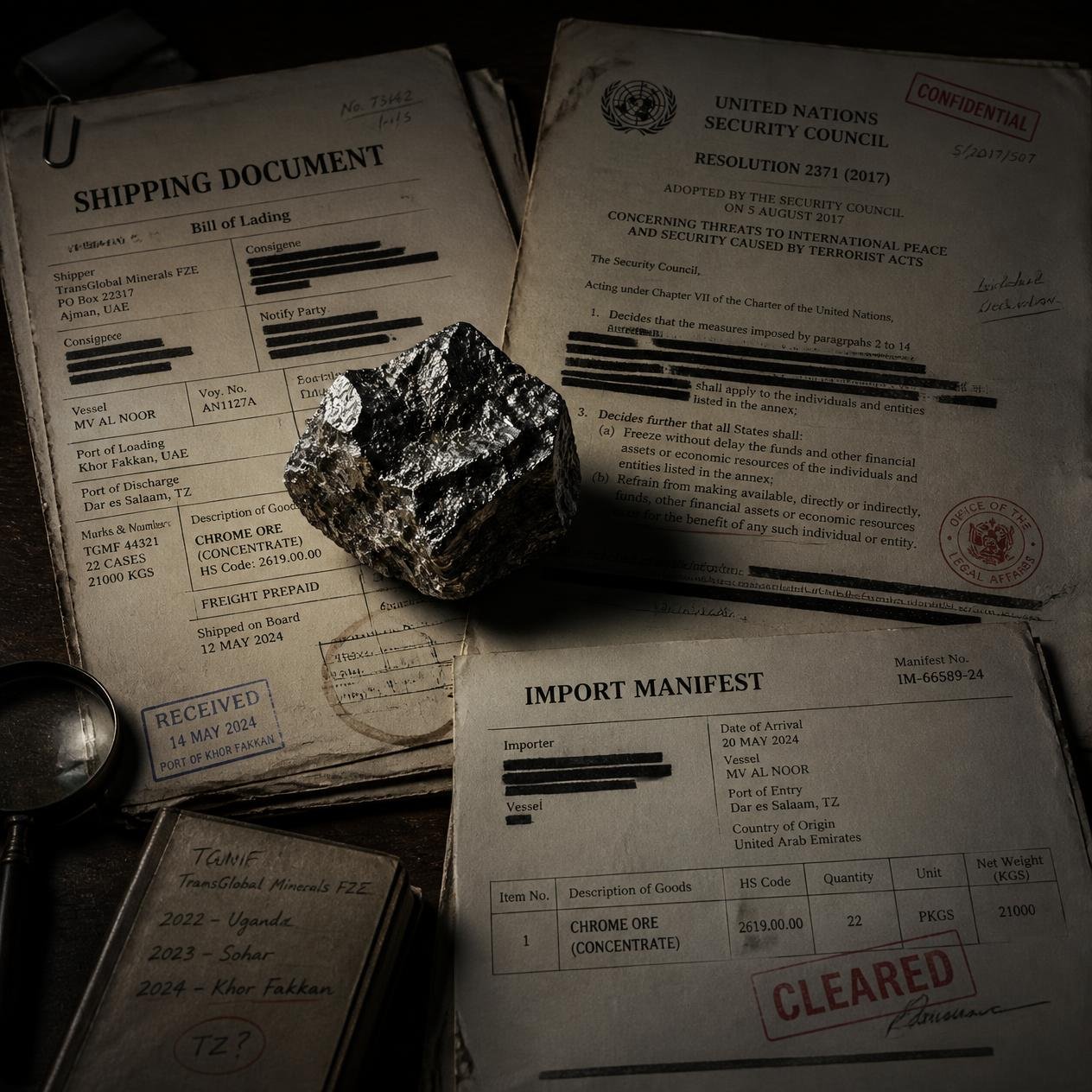
This covert policy of relaxation became a major international scandal in 1971 with the passage of the Byrd Amendment. Sponsored by Senator Harry F. Byrd Jr., the amendment to the Military Procurement Authorisation Act allowed the United States to import Rhodesian metallurgical-grade chrome, directly contravening the mandatory United Nations embargo. Supporters of the amendment, backed by influential American industrial conglomerates, contended that chrome was an essential, irreplaceable mineral for the aerospace and defense industries, particularly in the production of stainless steel, armor plating, and jet engines. Since the only other major global supplier of metallurgical-grade chrome was the Soviet Union, conservative legislators argued that dependence on a Cold War adversary for a critical defense mineral posed a significant threat to national security. The principal realpolitik justification for the Byrd Amendment was thus articulated as a matter of strategic necessity: in a zero-sum global conflict, the United States could not allow international treaties to compromise its industrial and military readiness.
Declassified records indicate significant inconsistencies and internal disagreements within the administration regarding this strategic defense. Officials were fully aware of the illegality of the imports. In a confidential memorandum to President Nixon, Henry Kissinger explicitly acknowledged that importing Rhodesian chrome would place the United States in direct violation of its binding international obligations under mandatory UN sanctions. Despite this knowledge, the White House did not actively oppose the legislation; instead, it permitted Congress to assume public responsibility while benefiting from the economic advantages provided to American steel corporations. This approach frustrated diplomats within the State Department's Bureau of African Affairs. Assistant Secretary David Newsom expressed concern about potential diplomatic repercussions, particularly among moderate African leaders such as Kenneth Kaunda of Zambia. When Newsom testified confidentially before the House Subcommittee on Africa, revealing that the State Department had recommended closing the U.S. Consulate in Southern Rhodesia and opposing chrome imports, the White House interpreted his testimony as an unauthorized disclosure. Kissinger and Nixon were dissatisfied with the State Department's revealed opposition, which underscored the administration's tacit support for the chrome lobby.
The principal realpolitik justification for the administration's southern African economic policy was that it represented a pragmatic response to safeguard Western security and maintain access to essential resources during a period of global economic instability. By maintaining economic relations with Rhodesia and neighboring white-ruled states, the administration sought to prevent regional radicalization and limit opportunities for Soviet and Chinese influence. From this perspective, international law and the United Nations were viewed as unpredictable and ideologically motivated, with resolutions often disconnected from the practical realities of global power. Kissinger argued that strict adherence to UN sanctions on Rhodesia would not advance majority rule, but would instead harm the local economy, provoke defensive reactions among the white population, and potentially facilitate the rise of a violent, Soviet-supported Marxist regime. He maintained that pragmatic engagement was the most effective strategy for preserving American influence and enabling a gradual, managed transition.
Nevertheless, the long-term diplomatic and ethical consequences of this policy undermine its realpolitik justification. By openly violating its treaty obligations, the United States weakened the framework of international law and multilateral cooperation that it had helped to establish. The breach of UN sanctions provided Ian Smith's regime with essential "political solace and economic fiber," enabling it to continue its conflict against the black majority for over a decade. This policy harmed Washington's relations with newly independent African states, which observed the United States importing resources from a pariah state while simultaneously advocating for human rights at the United Nations. Moreover, the approach demonstrated that Kissinger's conception of power extended beyond covert or military actions and was evident in economic policy. International law, sovereign immunity, and multilateral treaties were treated as negotiable instruments, subject to strategic or political considerations. In the context of the Cold War, the rights of six million black Rhodesians were subordinated to strategic interests, illustrating that, for the architects of realpolitik, access to critical resources was prioritized over adherence to international law.
Iraqi Kurdistan, 1972–1975: Armed to Bleed, Never Permitted to Prevail
The modern history of the Persian Gulf is characterised by a persistent power dynamic, in which smaller, stateless nations have repeatedly seen their aspirations for self-determination suppressed by the geostrategic maneuvers of larger states. In the early 1970s, Ba'athist Iraq occupied a volatile and increasingly radical regional position. Under President Ahmed Hassan al-Bakr and Vice-President Saddam Hussein, the Iraqi regime clashed repeatedly with its neighbor, the Imperial State of Iran, which in April 1969 unilaterally renounced the 1937 treaty governing the Shatt al-Arab waterway. This territorial rivalry escalated into sporadic border skirmishes, prompting Iraq to sever diplomatic relations with Tehran in December 1971. Facing regional isolation, the Ba'athist regime turned to Moscow, signing the Soviet-Iraqi Treaty of Friendship and Cooperation in April 1972. This agreement formalized a significant influx of advanced Soviet military hardware and raised concerns in Washington that a pro-Soviet client state might dominate the Persian Gulf. The British military withdrawal from the Gulf in December 1971 created a critical power vacuum. The Nixon administration, constrained by the Nixon Doctrine, sought to strengthen Iran under Shah Mohammad Reza Pahlavi as the primary American surrogate to protect Western oil interests and contain Soviet influence. The Shah, however, sought direct American involvement to counterbalance Iraq and possessed a highly effective "Kurdish card." He regarded the Iraqi Kurds not with genuine sympathy, but "as weapons" to keep the Iraqi army engaged in a costly domestic guerrilla conflict, thereby limiting Baghdad's capacity to project power in the Gulf or challenge Iranian primacy.
The covert framework of the American-Kurdish alliance was established during Richard Nixon and Henry Kissinger’s official state visit to Tehran in May 1972. Seeking to secure the Shah's role as the principal guardian of the Gulf, Nixon assured the Iranian monarch that there would be no "second-guessing of his requests" to acquire advanced American weaponry. Concurrently, the President and his National Security Advisor approved a highly sensitive plan to collaborate with Iran in covertly supporting the Kurdish Peshmerga guerrillas, led by nationalist leader Mulla Mustafa Barzani, in their pursuit of autonomy from Baghdad. This operation, which initially allocated millions of dollars in CIA funding, was conducted outside standard bureaucratic channels. It proceeded despite the strong objections of the U.S. Ambassador in Iran and without prior review by the Forty Committee, the interagency body responsible for overseeing clandestine activities. The State Department was deliberately excluded from knowledge of the operation, primarily because diplomats in Washington were simultaneously pursuing the establishment of a U.S. Interests Section in Baghdad to promote diplomatic relations—a goal at odds with the White House's secret efforts to undermine the Ba'athist regime. To maintain plausible deniability, the United States coordinated arms transfers with Israel and Jordan, employing "non-attributable" Soviet-designed weapons captured from Palestinian fedayeen to conceal direct American involvement.
The strategic rationale for this joint operation was grounded in a calculated realpolitik approach: the Kurds were to be armed sufficiently to sustain conflict, but not to achieve victory. Neither the Shah of Iran nor the United States supported the establishment of an independent or genuinely autonomous Kurdish state. A successful Kurdish nationalist movement in Iraq would have risked destabilizing Turkey, a key NATO ally, and threatening Iran, which also had a significant and suppressed Kurdish minority. Consequently, the operational objective was limited to providing Barzani's forces with only the support necessary to maintain a defensive campaign, ensuring the conflict remained unresolved and continued to deplete Iraq's resources. A declassified National Security Council memorandum prepared by Harold Saunders in June 1972 explicitly warned Kissinger that the United States and Iran "wished to encourage the Kurds to remain a source of instability" to tie down Iraq's army, but if the rebellion failed, Washington would lack both the means and the will to provide decisive support. This "no-win, no-lose" strategy, which regarded the Kurdish population as expendable assets, was intentionally concealed from Kurdish leaders. Within the strategic calculations of the White House, the Kurds were considered the "ultimate Cold War card" to be used and abandoned as required by shifts in the global balance of power.
The Iraqi Kurds were not passive actors, but rather strategic participants who had engaged in a prolonged, fourteen-year conflict for national rights. Mulla Mustafa Barzani and the Kurdistan Democratic Party reached a Peace Accord with Baghdad on March 11, 1970; however, the agreement quickly collapsed due to the Ba'ath regime's efforts to centralize power, alter the demographics of the oil-rich city of Kirkuk, and conduct political purges. Barzani recognized that the Shah of Iran was an unreliable and ruthless neighbor, having previously suppressed the Kurdish Republic of Mahabad in 1946. This longstanding distrust led the Kurdish leadership to repeatedly seek assurances from Washington, declining to reject Soviet-backed Ba'athist coalition proposals unless the United States provided direct involvement as an "insurance of a superpower guarantee." On July 30, 1972, Idris Barzani and Mahmoud Othman traveled to Washington for the highest-level meeting to date between the United States and the Kurds, presenting their case to CIA Director Richard Helms and Richard Kennedy of the National Security Council. Reassured by Kissinger’s personal messages and the Nixon administration's formal commitment, the Kurds placed their trust in the United States' reliability. With this perceived superpower guarantee, Barzani rejected the Ba'athist-imposed Autonomy Law in March 1974, initiating a large-scale military conflict that engaged two-thirds of the Iraqi army. Barzani later reflected on the consequences: "Without American promises, we would not have acted the way we did."
The extent of this manipulation became evident following the October 1973 Yom Kippur War. As Kissinger sought to establish a pro-American regional order and secure Israeli-Syrian military disengagement, he collaborated with Egyptian President Anwar Sadat on a plan for Iran to intensify unrest in Iraqi Kurdistan during the winter of 1973–1974. This strategy aimed to compel Iraq to withdraw military forces from the Syrian front, thereby facilitating negotiations. When Israeli officials informed Kissinger in March 1974 that the Kurds required additional assistance, his response to Ambassador Simcha Dinitz revealed a transactional approach: "You can tell them we have already taken action because it is in our interest to keep the Iraqis distracted while we are working on the Syrians." Although this approach achieved its immediate objective, it also contributed to the escalation of a full-scale Kurdish conflict. When Barzani requested offensive weapons to conduct preemptive strikes on Iraqi oil installations or military targets, Kissinger and the Shah consistently rejected these proposals, instructing the CIA to advise the Kurds against offensive operations. They feared that a decisive Kurdish victory would destabilize the region, threaten access to energy resources, and provoke a broader crisis, opting instead to confine the Peshmerga to a defensive posture.
The operation's underlying strategy was ultimately revealed in March 1975, when the geostrategic context shifted decisively. By the winter of 1974–1975, the military situation in Iraqi Kurdistan had deteriorated, as the Iraqi army, supported by Soviet bomber divisions, forced the Peshmerga into retreat. The Shah recognized that sustaining the Kurdish rebellion would require a substantial Iranian troop deployment and the risk of a border conflict with Iraq, a commitment he was unwilling to make. Consequently, the Shah opted to exchange support for the Kurds for a favorable settlement of his border dispute with Baghdad. On March 5–6, 1975, during an OPEC Summit in Algiers, Saddam Hussein and the Shah signed the Algiers Agreement. In return for Iran sealing its border and ending all support for the Kurdish rebellion, Iraq agreed to cede the deep-water thalweg demarcation of the Shatt al-Arab waterway to Iran, granting the Shah a significant regional advantage. Although Kissinger was privately displeased with the Shah's unilateral decision, the Ford administration quickly acquiesced, declining to pursue the alternative of expanded direct U.S. aid, which Scowcroft estimated would require $300 to $500 million annually with uncertain prospects for success.
The consequences of this abrupt policy shift were severe. The Shah rigorously enforced the Algiers Accord, immediately closing the northern border and severing the Peshmerga's access to weapons, medicine, and food. The Iraqi army subsequently launched a large-scale, unopposed offensive in Kurdistan, resulting in the execution of thousands of Peshmerga fighters, the destruction of numerous villages, and a campaign of ethnic cleansing that forcibly relocated hundreds of thousands of Kurds to southern Iraq. On March 10, 1975, Mustafa Barzani sent a personal appeal to Kissinger, expressing that "our movement and people are being destroyed in an unbelievable way" and requesting direct U.S. intervention. Kissinger did not respond, instructing his staff to maintain silence. When Barzani was later diagnosed with terminal lung cancer, the Ford administration allowed him to enter the United States for medical treatment. This decision was motivated not by compassion, but by a calculated effort by the CIA and the White House to monitor Barzani, restrict his contact with the press, and prevent disclosure of the covert operation's details to the American public.
The covert operation was ultimately revealed in early 1976, when a leaked draft of the House Select Committee on Intelligence (the Pike Committee) was published in The Village Voice, disclosing the details of Project FUBELT and the Kurdish operation to the American public. The committee’s final report delivered a strong indictment of the administration's actions, concluding that the United States and Iran had "hoped that our clients would not prevail" but had encouraged continued Kurdish resistance solely to deplete Iraq's resources, stating that "Even in the context of covert action, ours was a cynical enterprise." When questioned about these findings during a closed-session congressional hearing, Henry Kissinger responded, "Covert action should not be confused with missionary work." This statement encapsulated the core logic of realpolitik. During the Cold War, the survival of the Kurdish people was treated as expendable, sacrificed to maintain the balance of power. The mountains of Iraqi Kurdistan, marked by the loss of the Peshmerga, remain a testament to a period when an ally was armed to suffer losses but systematically denied the possibility of achieving peace.
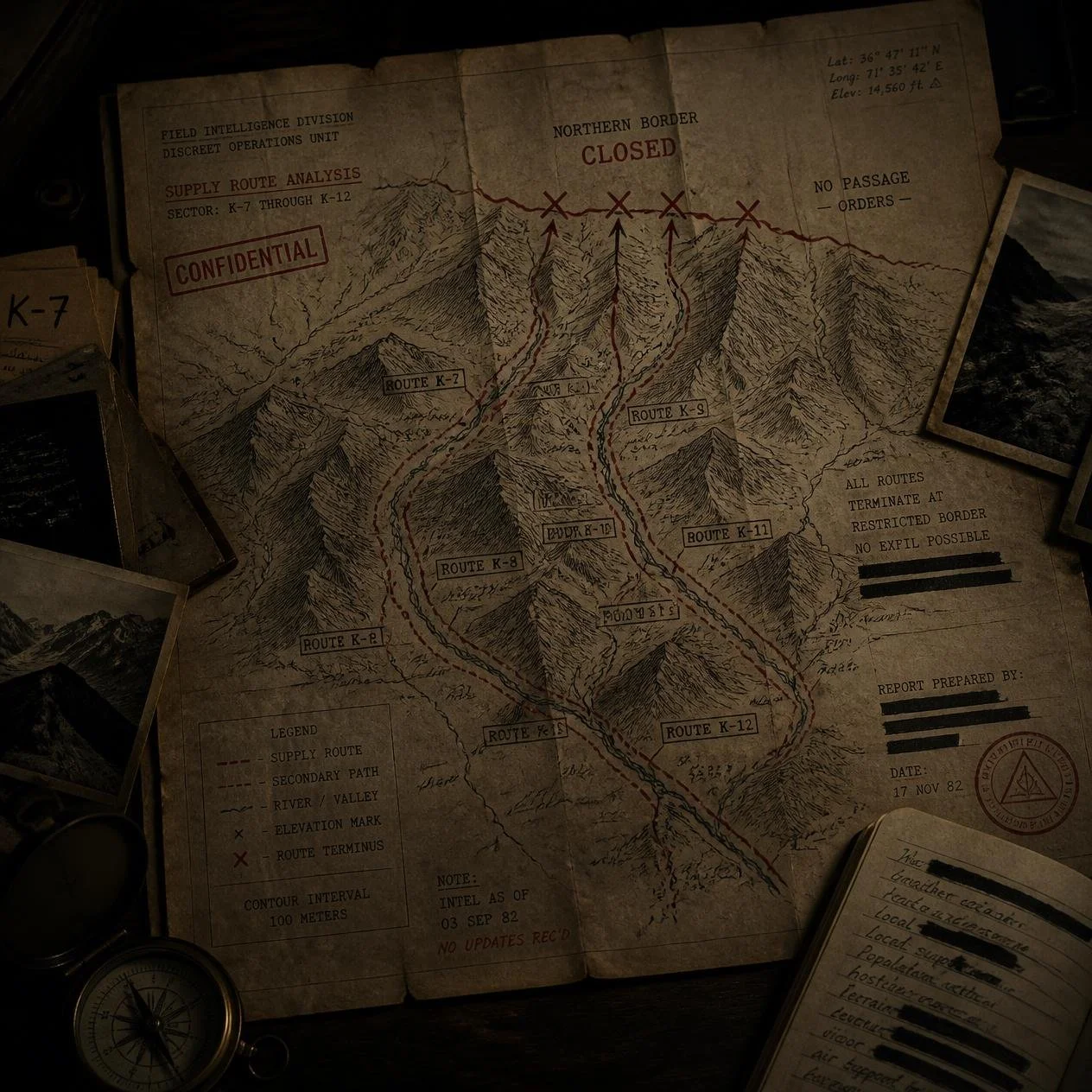
East Timor, 1975: United States Endorsement and the Prelude to Invasion
In the autumn of 1975, Southeast Asia’s geostrategic environment was characterized by Western withdrawal and increasing instability. The rapid collapse of American-supported regimes in South Vietnam, Cambodia, and Laos earlier that year created what United States policymakers perceived as a volatile power vacuum. Influenced by the "domino theory," the Ford administration prioritized alliances with strong, anti-communist regional partners to maintain stability. Indonesia, the region’s most populous and strategically significant nation under General Suharto, was central to this strategy. The abrupt decolonization of Portuguese East Timor following the fall of Lisbon’s regime in April 1974 created a political vacuum on the eastern half of the island bordering Indonesian West Timor. The swift emergence of Fretilin (the Revolutionary Front for an Independent East Timor), a left-leaning nationalist movement that declared independence on November 28, 1975, alarmed Jakarta. Suharto, determined to prevent a "communist-dominated" enclave within the Indonesian archipelago, prepared for a unilateral military invasion to annex the territory. Achieving this objective, however, required the diplomatic and military acquiescence of Indonesia’s principal patron, the United States.
Despite the gravity of the impending regional crisis, American foreign policy officials regarded East Timor as a low-priority issue. In briefing materials prepared for President Gerald Ford’s Far East tour in November 1975, the East Timor question was listed last, underscoring its marginal status compared with the priority of maintaining strong relations with Jakarta. Kissinger and his staff were aware of the legal and political risks. United States bilateral treaties and domestic laws restricted military assistance to Indonesia to defensive purposes; any offensive action against East Timor would constitute an illegal use of American-supplied weapons, necessitating an immediate embargo and suspension of arms transfers. A briefing paper by Edward Ingraham explicitly warned that using United States weapons in an occupation of East Timor would violate American law, noting that this restriction had previously constrained Jakarta. Nevertheless, as Ford and Kissinger prepared to arrive in Jakarta, they did not intend to allow statutory human rights laws or the aspirations of the 700,000 East Timorese to interfere with their strategic partnership with Suharto. United States intelligence had already confirmed that Indonesia had finalized its invasion plans. On December 4 or 5, while in Beijing, Kissinger received a classified cable titled "Plans for Indonesian Invasion of East Timor," ensuring that the American delegation was fully aware of the imminent assault upon arrival in Jakarta on December 6, 1975.
The historic transaction that occurred inside the presidential palace in Jakarta on December 6, 1975, represents one of the most starkly documented "green lights" in the annals of modern realpolitik. The declassified State Department telegram recording the private meeting between Ford, Kissinger, and Suharto dismantles decades of subsequent denials. The session began not with a discussion of human rights, but with Ford expressing "enthusiasm" for building an M-16 munitions plant in Indonesia to supply small arms to combat regional insurgencies, a proposal Kissinger warmly endorsed as an indication of "wider cooperation". Suharto then brought up East Timor, presenting a highly calculated, distorted framing of the local conflict. Claiming that Fretilin was "infected... with communism" and had refused to negotiate, Suharto asserted that "the four other parties" favored integration with Indonesia. He then delivered his explicit request: "We want your understanding, if we ”
President Gerald Ford’s response was immediate and unambiguous: "We will understand and will not press you on the issue. We understand the problem and your intent with the political assent secured, Henry Kissinger intervened to address the critical "problems" of legal exposure and timing. Fully aware that over 90 percent of the weapons to be used in the invasion were supplied by the United States, Kissinger warned the dictator of the domestic legal hurdles: "the use of U.S.-made arms could create problems... It depends on how we construe it; whether it is in self-defense or is a foreign operation"” Having thus signalled that the administration was prepared to creatively "construe" an offensive invasion of a sovereign territory as "self-defence," Kissinger transitioned to operational advice, instructing the dictator: "it is important that whatever you do succeeds quickly". He then requested a specific tactical delay to protect the American delegation from direct political association with the bloodshed, advising Suharto: "We would be able to influence the reaction if whatever happens, happens after we return... the President will be back on Monday at 2 PM Jakarta time. We understand your problem and the need to move quickly, but I am only saying that it”
Suharto closely followed the timeline outlined by the American Secretary of State. The United States delegation departed Jakarta on the afternoon of December 6. Within sixteen hours, on the morning of December 7, 1975, the Indonesian military launched a full-scale assault on Dili. Armed with American M-16 rifles, supported by United States-supplied armored vehicles, and protected by three United States-supplied naval destroyers encircling the island, Indonesian airborne troops initiated a campaign characterized by extreme violence. In the initial days, Dili experienced systematic looting, mass executions, and widespread sexual violence. The Fretilin-declared republic was rapidly dismantled, and the territory was annexed as Indonesia’s twenty-seventh province. Over the next twenty-five years, a low-intensity guerrilla resistance confronted a scorched-earth counterinsurgency. Indonesian forces used United States-supplied Bronco aircraft, designed for rugged terrain, to deploy napalm and chemical defoliants, destroying agriculture and causing a man-made famine. A United Nations truth commission and independent human rights organizations later estimated that between 100,000 and 230,000 East Timorese civilians died during the occupation from violence, starvation, and disease, representing more than one-fifth of the population.
The immediate response within Washington’s bureaucracy involved covert damage control and efforts to maintain "plausible deniability." On December 18, 1975, shortly after returning to Washington, Kissinger convened a contentious staff meeting with senior State Department officials, the transcript of which was later declassified. His anger was directed not at the violence in Dili, but at his legal advisor, Monroe Leigh, and Assistant Secretary Philip Habib, who had formally documented that the invasion was illegal and required an arms embargo. Kissinger admonished his subordinates: "I want to raise a little bit of hell about the Department's conduct in my absence... Take this cable to Timor. You know my mind and attitude, and anyone who knows my position as you do must know that I would not have approved it. The only consequence is to put yourself on record. It is a disgrace to treat the Secretary of State this way." When Leigh noted, "The Indonesians were violating an agreement with us," Kissinger responded with a self-justifying rationale: "And we can't construe a Communist government in the middle of Indonesia as self-defense?" He made his concern with legal exposure explicit: "On the Timor thing, that will leak in three months, and it will come out that Kissinger overruled his pristine bureaucrats and violated the law. How many people in L [the legal advisor's office] know about this?"
To circumvent legal restrictions, the State Department implemented a sophisticated strategy of administrative deception. Officials ordered an administrative "delay" on new arms sales while covertly processing existing orders and establishing back channels to maintain the flow of military equipment to Indonesia. Six months later, on June 17, 1976, Under Secretary Philip Habib confirmed in a private staff meeting that the cover-up had been effective: "We've resumed, as you know, all of our normal relations with them; and there isn't any problem involved." Kissinger responded with a revealing assessment: "Not very willingly. Illegally and beautifully." When Ambassador Daniel Patrick Moynihan was tasked with defending the annexation at the United Nations, he diligently followed Kissinger’s instructions to ensure the United Nations remained "utterly ineffective in whatever measures it undertook." Moynihan later acknowledged in his memoirs that he had accomplished this "with no inconsiderable success," allowing the annexation to proceed without international challenge.
For more than two and a half decades, Henry Kissinger engaged in a campaign of flat denials, memory lapses, and historical erasure regarding his complicity in the tragedy in Timor. In his massive, three-volume memoirs totaling nearly four thousand pages, East Timor was completely airbrushed out, failing to appear anywhere in the indices or the text—an omission designed to bury the episode in historical oblivion. When confronted publicly in August 1995 by former East Timorese resistance leader Constancio Pinto and investigative journalist Allan Nairn, who presented the unsealed declassified transcripts, Kissinger resorted to evasive, improvised fabrications. He claimed that "Timor was never discussed with us when we were in Indonesia," asserting that he had only learned of the invasion plans "at the airport" as they were leaving. When Nairn pointed out that the official transcripts recorded him advising Suharto on how to "construe" the invasion as self-defense and asking him to delay the assault until Air Force One had landed, Kissinger dismissed the documents, thumping his podium and declaring that "Timor was not significant.”
The declassified record fundamentally challenges conventional notions of responsibility in international relations. Formally, the United States neither authorized the invasion nor directed Indonesian military operations, a defense frequently cited by Kissinger’s supporters. However, the transcripts demonstrate that the distinction between formal authorisation and tacit approval was minimal. By expressing "understanding" of Suharto’s intentions, offering to interpret the invasion as self-defense, providing a timeline to reduce domestic repercussions, and actively circumventing U.S. laws to maintain arms supplies, Ford and Kissinger did more than ignore the impending violence. They established a diplomatic and legal framework that enabled a campaign of mass violence to proceed without consequence. In the logic of realpolitik, East Timor became expendable—a "little speck of an island" sacrificed to fulfill the strategic objectives of a major power, resulting in a quarter-century of genocide as the enduring consequence of this communicated tolerance.
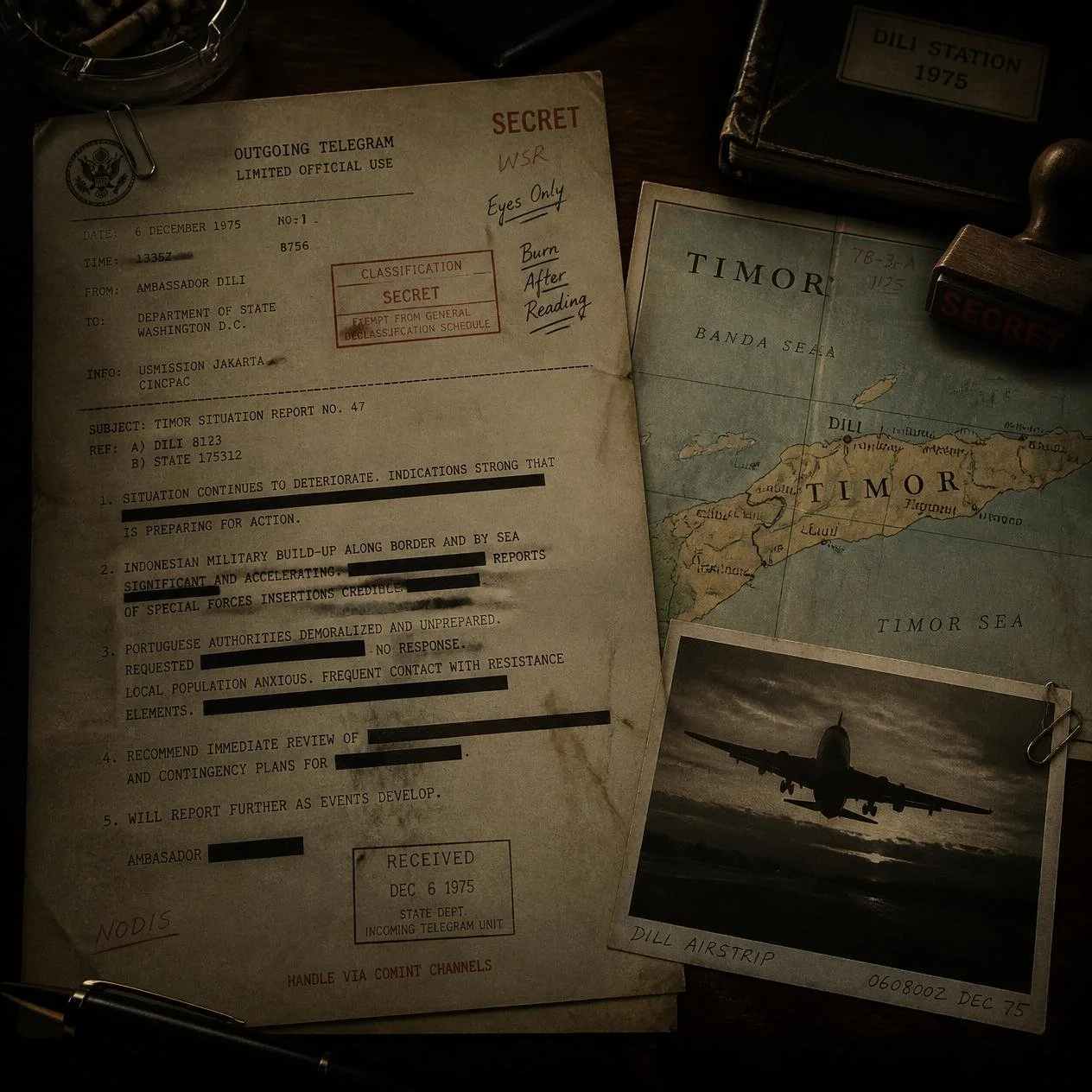
Argentina, 1976: “Do It Quickly”: When Diplomacy Sounded Like Permission
The military coup of March 24, 1976, which overthrew the chaotic and crumbling government of Isabel Perón, initiated the most savage chapter of political violence in modern Argentine history. The newly installed military junta—led by Army General Jorge Rafael Videla, Navy Admiral Emilio Eduardo Massera, and Air Force Brigadier Orlando Ramón Agosti—formalised their dictatorship under the clinical title of the Proceso de Reorganización Nacional. Seeking to completely eradicate leftist guerrilla organisations like the Montoneros and the Marxist Revolutionary Army of the People (ERP), the regime launched a highly coordinated, clandestine campaign of state-sponsored terror. This "Dirty War" (la guerra sucia) far exceeded conventional bounds of counterinsurgency, rapidly developing into a systematic campaign of extrajudicial detentions, torture, child kidnapping, and mass murder. Over the subsequent seven years, the military established more than four hundred secret concentration camps—including the notorious Navy Mechanics School (ESMA)—where thousands of civilian dissidents, union organisers, and student activists were systematically tortured, injected with sedatives, and loaded onto military cargo planes to be dropped alive into the freezing waters of the Río de la Plata. This domestic repression operated within a broader, increasingly volatile regional security environment. Argentina sat at the geographic and operational center of Operation Condor, the transnational intelligence alliance of Southern Cone dictatorships organized to track down, kidnap, and assassinate political exiles across international borders.
In the months preceding the March 24 takeover, Argentine military commanders had actively sought to gauge the United States' reaction to a potential coup. In February 1976, Ambassador Robert C. Hill—a deeply conservative, veteran Republican diplomat who had previously served in Costa Rica, El Salvador, Mexico, and Spain—called on Air Force Commander-in-Chief Agosti, who pointedly asked for Hill's assessment of Argentina's political vacuum. Hill responded cautiously, emphasizing that solutions to Argentina’s difficulties must come from the Argentines themselves, while signaling that the United States would recognize a government capable of maintaining order and discharging its international obligations. Admiral Massera also met privately with Hill on March 16, warning him that the military would soon have to step into the political vacuum to prevent total chaos.
Initially, Hill expressed strong approval of the coup, describing it in official dispatches as "probably the best executed and most civilized coup in Argentine history."
However, as the chilling reality of the repression became undeniable, Hill’s professional and moral complicity was severely tested. By late April 1976, the regime had arrested over 1,500 political figures and dissidents, and by August, the number of political prisoners had surged to over 5,000. In May, a series of high-profile atrocities directly implicated the military’s security forces: the prominent Uruguayan opposition politicians Zelmar Michelini and Héctor Gutiérrez Ruiz were abducted in Buenos Aires, tortured at a secret facility, and found shot to death in a car, while right-wing death squads operating with total official immunity kidnapped U.S. citizens and Fulbright coordinator Elida Messina.
Confronted with mounting evidence of mass murder, Ambassador Hill resolved to address the issue directly. On May 25, 1976, he bypassed standard procedures to urgently request authorization from Washington to deliver a formal démarche. Upon receiving approval, Hill met with Foreign Minister César Augusto Guzzetti on May 27 to present a stern written warning. Hill informed Guzzetti that while the United States sympathized with President Videla's struggle against subversion, fundamental norms of human rights and the rule of law could not be disregarded by any civilized government. He cautioned that the unchecked impunity of Triple A-type death squads was damaging Argentina's international reputation and causing significant concern among its allies. After the meeting, Hill reported to Washington with increasing apprehension: "I did not have the impression he really got the point.”
The reason Guzzetti did not "get the point" was that he was receiving a vastly different, more powerful signal from the absolute pinnacle of the American foreign policy establishment. On June 10, 1976, during the Organization of American States (OAS) General Assembly in Santiago, Chile, Secretary of State Henry Kissinger held an extraordinary, sixty-five-minute bilateral meeting with Foreign Minister Guzzetti in his private hotel suite. Guzzetti immediately asked for U.S. "understanding and support" on internal security and economic aid, framing the junta's campaign as a necessary war against "terrorism".
Kissinger's response, recorded in the declassified verbatim memorandum of conversation, was highly reassuring. Kissinger told Guzzetti: "We have followed events in Argentina closely. We wish the new government well. We wish it would succeed. We will do what we can to help it succeed... We are aware you are in a difficult period... We understand you must establish authority."
Then Kissinger delivered the fateful, precise instruction: "If there are things that have to be done, you should do them quickly. But you must get back quickly to normal procedures." During the meeting, Guzzetti committed a significant diplomatic gaffe by openly describing the regional operations of Operation Condor at the table. Guzzetti informed the Secretary that 500,000 exiles from the Southern Cone lived in Argentina, that 10,000 of them were terrorists, and that Argentina was actively "encouraging joint efforts to integrate with our neighbors," including Chile, Paraguay, Bolivia, Uruguay, and Brazil, to combat them. Kissinger, realizing the severe legal and political dangers of having a state-sponsored international assassination ring formally documented on his watch, sharply redirected the conversation, interjecting: "I take it you are talking about joint economic activities?" When Guzzetti quickly took the cue and agreed, a mollified Kissinger remarked, "That sounds like a good idea." At the end of the meeting, Kissinger and Guzzetti retired from the room for a completely private, unrecorded conversation that lasted four minutes, leaving his own professional staff excluded.
To analyze this historic meeting, it is necessary to distinguish among various forms of diplomatic influence: direct orders, active encouragement, reassurance, tolerance, and failure to restrain. The principal realpolitik defense of Kissinger—advanced by his supporters and close associate William D. Rogers—maintains that Kissinger’s language did not amount to a direct order or explicit encouragement of state violence. According to this realist interpretation, Kissinger’s instruction to "do it quickly" was a pragmatic warning about the constraints of American domestic politics. He cautioned Guzzetti that the Ford administration faced significant congressional and public pressure over human rights and that failure to promptly restore "normal procedures" would likely lead Congress to enact laws to cut off military aid and block international loans. In this reading, Guzzetti engaged in "selective listening," disregarding the pragmatic warnings about public opinion and focusing instead on the Secretary’s diplomatic reassurances.
This realist defense is challenged by considering how diplomatic signals are interpreted by an allied military government seeking implicit permission to act. For a junta that perceived itself as engaged in a critical war against international subversion, the Secretary of State's advice to "do it quickly" served as a geostrategic license. Within the rigid logic of counterinsurgency, "doing it quickly" was interpreted as a directive to intensify the campaign of torture, executions, and disappearances to eliminate opposition before the U.S. Congress could intervene or a new American president assumed office. Kissinger’s omission of explicit references to human rights or the rule of law during the meeting served as a tacit signal of tolerance. By indicating that the executive branch would "do what we can to help you succeed" and advising the regime to minimise its political exposure in Washington, Kissinger shifted from a neutral observer to an active, silent partner in the repression. This communicated tolerance is substantiated by the chronology: extrajudicial disappearances and murders in Argentina reached their peak in the months immediately following this meeting, between June 1976 and January 1977.
The profound bureaucratic chasm created by this parallel diplomacy soon produced a severe crisis within the American foreign policy apparatus. While Ambassador Hill and his deputy, Max Chaplin, in Buenos Aires continued to lodge formal protests over massacres and disappearances—such as the dumping of forty-seven bodies at Pilar and the murder of Catholic priests—Guzzetti and Videla systematically dismissed their concerns. On September 21, 1976, Hill finally obtained his first formal audience with General Jorge Rafael Videla. When Hill raised human rights and warned that newly enacted U.S. laws could freeze military and economic assistance, Videla flatly dismissed the warnings. Videla told the ambassador that he had been "gratified" when Foreign Minister Guzzetti returned from Santiago and reported that Secretary Kissinger "understood their problem"” Videla then delivered a devastating, calculated insult to the career diplomat, telling Hill that he had the distinct impression that "senior officers of the USG understood [the] situation his government faces, but junior bureaucrats do not"—unmistakably categorising the U.S. Ambassador as a misinformed, low-level clerk whose warnings could be safely ignored.
The climax of this diplomatic tragedy occurred in October 1976, when Admiral Guzzetti traveled to the United States. On October 6, Guzzetti met in Washington with Deputy Under Secretary Charles Robinson and Assistant Secretary Harry Shlaudeman, who delivered firm warnings about the intense hostility of the U.S. public and Congress toward the ongoing disappearances. But the next day, October 7, Guzzetti met with Kissinger in New York. Once again, Kissinger completely neutralized the warnings of his own professional staff. "Look," Kissinger told the Argentine foreign minister, "our basic attitude is that we would like you to succeed. I have an old-fashioned attitude that friends ought to be supported... The quicker you succeed, the better.” Kissinger explicitly assured Guzzetti that the United States would not "cause you unnecessary difficulties" and had "no intention" of voting against two pending international loans for Argentina, effectively assuring the regime that the executive branch would shield it from the economic consequences of its state-sponsored terror.
Foreign Minister Guzzetti returned to Buenos Aires on October 14 in a state of absolute, euphoric "jubilation". When Ambassador Hill met him at the airport, Guzzetti was glowing, and the next day, October 15, He greeted Hill with an effusive, highly uncharacteristic abrazo (hug). Over a 35-minute conversation, an ecstatic Guzzetti told the ambassador about the immense success of his trip, boasting that the U.S. government had "no real problem" with Argentina's human rights practices and that the "consensus of the meeting was to get the terrorist problem over as soon as possible.”
A deeply demoralized and outraged Ambassador Hill cabled a bitter, extraordinary protest directly to Washington. Hill warned his superiors that Guzzetti's remarks were "not those of a man who has been impressed with the gravity of the human rights problem... He has returned in a state of jubilation, convinced that there is no real problem with the U.S. government over this issue. Hill concluded that Guzzetti’s report to Videla and the cabinet would permanently convince the regime that U.S. criticism was limited to biased and misinformed segments of Congress, making it henceforth "unrealistic and ineffective" for the embassy to continue to press it.
In Washington, Shlaudeman quickly placed Hill's cable on Kissinger’s desk, proposing to "respond for the record" to cover their bureaucratic flank. On October 22, 1976, Shlaudeman sent a highly sensitive, personal cable back to Hill. The response attempted to reframe the meetings, asserting that Guzzetti "heard only what he wanted to hear" and attributing the discrepancy to Guzzetti's "poor grasp of English" or his "filter". Yet, the declassified transcripts of the October 7 meeting reveal that Guzzetti's "grasp of English" was completely irrelevant—Guzzetti had utilised an official interpreter, and his summary of Kissinger's remarks was chillingly, forensically accurate. By claiming that Guzzetti had merely misunderstood, Kissinger’s State Department was perpetrating a final, internal deception to silence its own ambassador. Through the careful deployment of communicated tolerance, double-talk, and executive shielding, Kissinger had ensured that the Argentine military was granted the necessary time to wage its bloody campaign of state terror, while leaving the American diplomats on the ground to watch in helpless, silent horror.
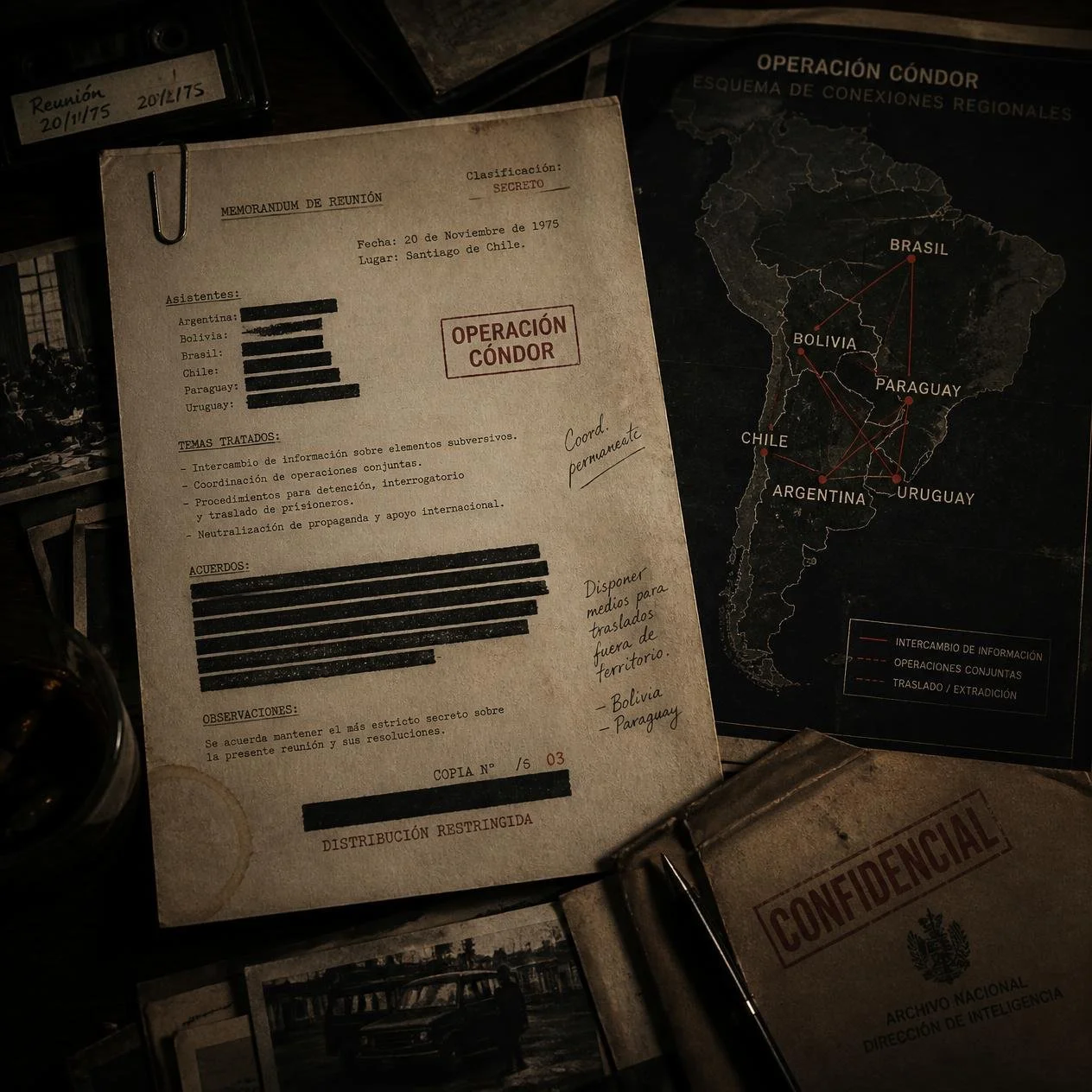
Washington, 2023: The Reputation That Survived the Record
At the time of his death from heart failure in Kent, Connecticut, on November 29, 2023, at the age of one hundred, Henry Alfred Kissinger was the last surviving former cabinet member of the Richard Nixon administration. His passing generated a sharply polarized public response, emphasising the unresolved duality of his extensive career in power. In Washington, London, and Beijing, political elites and heads of state commemorated him as a distinguished statesman who shaped the twentieth-century global order. In contrast, in Santiago, Dacca, and Dili, his death prompted enduring condemnation. Chile’s ambassador to the United States, Juan Gabriel Valdés, issued a statement acknowledging Kissinger’s "brilliance" while also denouncing his "profound moral wretchedness," a sentiment echoed by Chilean President Gabriel Boric. In Bangladesh, Foreign Minister AK Abdul Momen asserted that Kissinger had committed "inhumane things" during the 1971 liberation war and stated that he "should have apologised to the people of Bangladesh for what he has done". This pronounced geopolitical divide highlights the central paradox of Kissinger’s legacy: the coexistence of two fundamentally irreconcilable historical narratives.
The persistence of Kissinger’s reputation, despite the gradual disclosure of his classified activities, can be attributed to his deliberate transformation into an elder statesman after leaving office in January 1977. Although his tenure as a high-ranking policymaker had ended, he remained active in public life. He established a lucrative private platform, delivering lectures for substantial fees, securing a significant annual advisory contract with NBC, and integrating into influential social circles in New York and Connecticut. From this position, he authored three extensive memoirs—White House Years, Years of Upheaval, and Years of Renewal—collectively spanning nearly four thousand pages and earning the National Book Award. These works were designed to shape historical judgment in advance. By embedding regional controversies within comprehensive diplomatic narratives, administrative timelines, and strategic arguments, Kissinger constructed a robust narrative defense, presenting his decisions as tragic but necessary responses to global instability rather than as moral failures.
However, this carefully constructed narrative was persistently challenged by Kissinger’s own archival records. Beginning in the late 1960s, he implemented a "dead key" telephone extension system, instructing staff to covertly monitor and transcribe nearly all of his telephone conversations, except for the most personal ones. This practice produced an extensive, confidential archive of near-verbatim transcripts, known as "telcons." Before leaving office in late 1976, Kissinger covertly transferred thirty crates of these official documents, along with his diaries and backchannel records, to the bomb shelter at Nelson Rockefeller's Pocantico Hills estate, claiming they were private working papers. He later donated them to the Library of Congress under strict conditions that restricted researcher access until at least five years after his death. This action led to a significant legal dispute. The National Security Archive at George Washington University threatened to file a lawsuit against the State Department and the National Archives for failing to produce government records. This unprecedented challenge compelled the State Department to seek the return of the documents, initiating a prolonged "declassification revolution" that gradually undermined Kissinger’s plausible deniability.
At the same time, Kissinger developed a highly confidential and profitable corporate advisory model. In July 1982, alongside former national security deputy Brent Scowcroft and diplomat Lawrence Eagleburger, he established Kissinger Associates, Inc. (KAI). KAI operated with strict confidentiality and did not register as a lobbying entity. Instead, it charged substantial retainers to multinational corporations such as Union Carbide, Chase Manhattan Bank, and American Express, facilitating discreet access to foreign governments and heads of state. Through this role as a private corporate diplomat, Kissinger maintained his influence in Washington, serving as an informal adviser to presidents from both major political parties.
This strict commitment to commercial secrecy ultimately led to Kissinger’s most prominent domestic controversy. In November 2002, following the September 11 terrorist attacks, President George W. Bush appointed Kissinger as chair of the newly formed bipartisan 9/11 Commission. The appointment was immediately met with strong skepticism from a coalition of 9/11 victims' families and investigative journalists. Concerned about KAI's consulting relationships with the Saudi royal family, the families demanded full disclosure of Kissinger’s corporate clients. During a private meeting with a group of 9/11 widows, the families insisted on complete transparency. One widow recounted that Kissinger appeared visibly unsettled, spilling his coffee and attributing it to a vision problem. Ultimately, faced with the choice between resignation and revealing his confidential client list, Kissinger resigned from the commission on December 13, 2002, just two weeks after his appointment.
In the early twenty-first century, the ongoing declassification of Kissinger’s telcons and cables transformed his image in many international contexts from that of a respected elder statesman to a subject of significant legal scrutiny. Christopher Hitchens published The Trial of Henry Kissinger, a bestselling critique arguing that the former Secretary of State should face criminal prosecution under international law for war crimes, kidnapping, and conspiracy to commit murder. This campaign coincided with tangible legal actions. Spanish judge Baltasar Garzón, known for orchestrating the arrest of Chilean dictator Augusto Pinochet in London, issued a formal summons for Kissinger. French judges sent police officers to his Paris hotel to serve subpoenas regarding the disappearance of French citizens during Pinochet's regime. In 2002, human rights activist Peter Tatchell petitioned a British court to issue an arrest warrant for Kissinger during his visit to London, citing his alleged responsibility for civilian deaths in Indochina. In response to these legal threats, Kissinger restricted his international travel, operating primarily within the secure environments of Washington and the elite corporate circles of New York.
The central historical and philosophical question of Kissinger’s legacy is how his reputation endured despite a devastating, declassified paper trail. The explanation lies in the unique, systemic architecture of the Washington establishment. For decades, the foreign policy elite maintained an unwritten code of professional protection, interpreting Kissinger's actions not as international crimes but as dispassionate, necessary calculations of realpolitik. To his defenders, his achievements remained monumental: the opening to China, the Strategic Arms Limitation Treaty (SALT I) with the Soviet Union, and the shuttle diplomacy that stabilised the Middle East. In this perspective, the regional catastrophes that occurred during his tenure were viewed as unfortunate but necessary costs of securing a stable, global great-power equilibrium in a dangerous nuclear era.
However, the release of declassified documents has fundamentally undermined the plausible deniability provided by realist defences. For historians, these records demonstrate that the human costs associated with this equilibrium were not incidental or peripheral, but rather the direct results of a deliberate exercise of power. In every region where Kissinger implemented balance-of-power strategies, the consequences reflected a calculated and frequently cynical approach to statecraft.
Ultimately, the duality of Henry Kissinger’s legacy remains unresolved. The declassified archives do not offer a simplistic choice between a peerless diplomatic genius and an amoral war criminal; instead, they reveal a far more unsettling systemic reality. Both interpretations are forensically correct, each drawing from the same extensive, unvarnished paper trail. The final, tragic lesson of his statecraft is one of perspective. It demonstrates that in the architecture of international relations, diplomacy is remembered, celebrated, and institutionalized at the negotiating table, while its true, devastating costs are recorded in the silent graves of the countries that bore the price for peace.
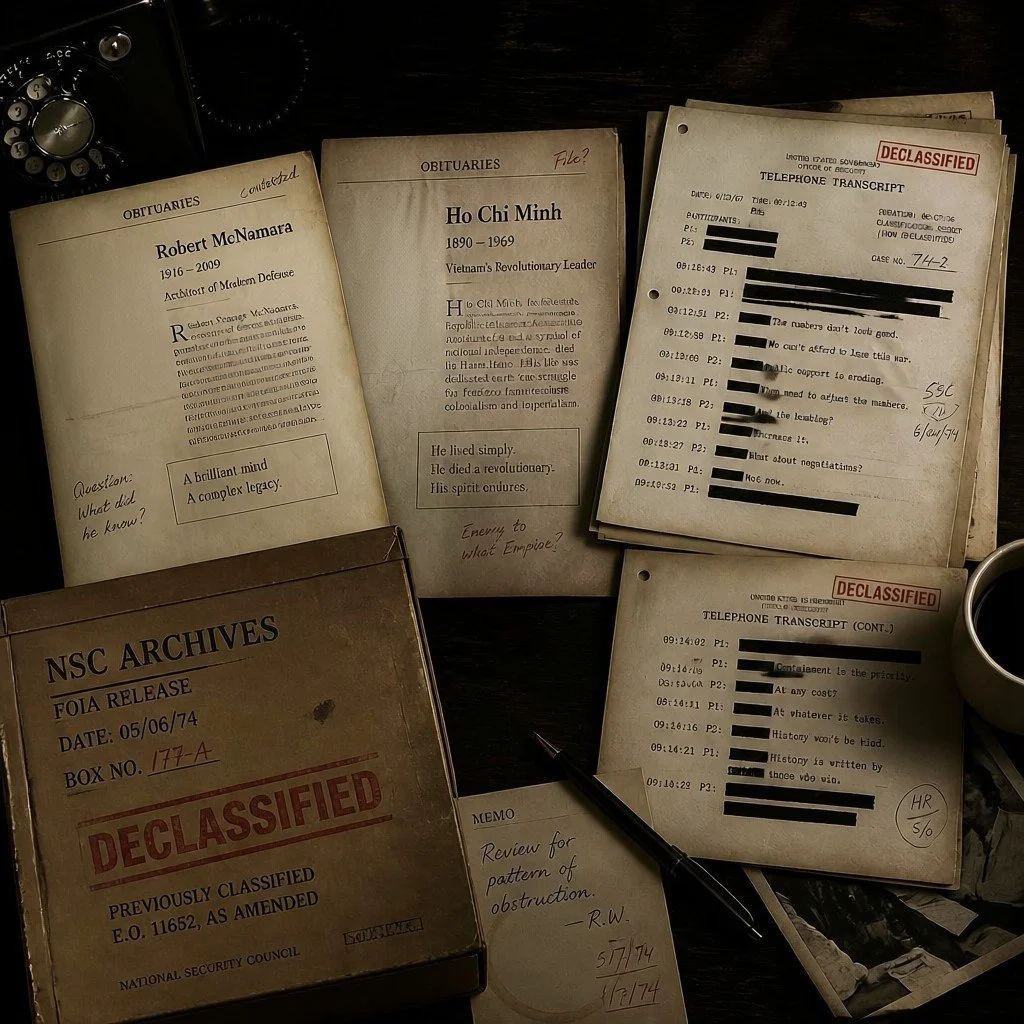
References
A Plane-Load of bombs every 8 minutes, 24 hours a day, for 9 years. (n.d.). https://www.opensocietyfoundations.org/voices/dramatic-effort-address-legacy-bombing-laos
ACoM. (2023, December 4). Late Henry Kissinger blamed for deaths of thousands. American Community Media. https://americancommunitymedia.org/spotlight-ethnic-media/late-henry-kissinger-blamed-for-deaths-of-thousands/
Ali, H. (2020). The Iraqi Kurds and the Cold War: Regional Politics, 1958–1975. In Routledge. Routledge. https://www.routledge.com/middleeaststudies/series/SE0823
Analysis: Henry Kissinger to Nixon | History | Research Starters | EBSCO Research. (n.d.). EBSCO. https://www.ebsco.com/research-starters/history/analysis-henry-kissinger-nixon
Aspinall, E., Mietzner, M., & Center on Democracy, Development, and The Rule of Law. (2008). From silkworms to bungled bailout: International influences on the 1998 regime change in Indonesia. In CDDRL WORKING PAPERS [Report]. Center on Democracy, Development, and The Rule of Law, Freeman Spogli Institute for International Studies, Stanford University. http://cddrl.stanford.edu
Bass, G. J., J. (2013). The Blood telegram : Nixon, Kissinger, and a forgotten genocide (First Edition, p. pages cm). Alfred A. Knopf.
Bose, M. (2014). Nixon, Kissinger and a forgotten Genocide. History Today, 64(10), 1–2. http://www.historytoday.com/print/1381
Burton, M. F., & Howard, A. M. (Eds.). (2014). Foreign Relations of the United States, 1969–1976, Volume E–9, Part 1, Documents on North Africa, 1973–1976.
Calandra, B. (2013). The killing zone. The United States Wages war in Latin America. Oxford University Press, 16(1), 117–118. https://aisberg.unibg.it/handle/10446/159842
Chile – Coup d’État, 1973. (n.d.). National Security Archive. https://nsarchive.gwu.edu/events/chile-coup-detat-1973
Chile and Operation Condor. (n.d.). https://nsarchive2.gwu.edu/NSAEBB/NSAEBB125/index.htm
Chile and the United States: declassified documents relating to the military coup, September 11, 1973. (n.d.). https://nsarchive2.gwu.edu/NSAEBB/NSAEBB8/nsaebb8i.htm
Church, F., Tower, J. G., Hart, P. A., Baker, H. H. Jr., Mondale, W. F., Goldwater, B., Huddleston, W. D., Mathias, C. McC. Jr., Morgan, R., Schweiker, R., Hart, G., MILLER, W. G. I., SCHWARTZ, F. a. O., SMOTHERS, C. R., & HATRY, A. (1975). COVERT ACTION IN CHILE 1963-1973. In STAFF REPORT OF THE SELECT COMMITTEE TO STUDY GOVERNMENTAL OPERATIONS WITH RESPECT TO INTELLIGENCE ACTIVITIES. https://www.intelligence.senate.gov/sites/default/files/94chile.pdf
CHURCH, F., TOWER, J. G., HART, P. A., BAKER, H. H., MONDALE, W. F., GOLDWATER, B., HUDDLESTON, W. D., MATHIAS, C. McC., MORGAN, R., SCHWEIKER, R. S., HART, G., MILLER, W. G., SCHWARZ, F. a. O., SMOTHERS, C. R., & HATRY, A. (1976). INTELLIGENCE ACTIVITIES AND THE RIGHTS OF AMERICANS BOOK II FINAL REPORT OF THE SELECT COMMITTEE TO STUDY GOVERNMENTAL OPERATIONS WITH RESPECT TO INTELLIGENCE ACTIVITIES. U.S. GOVERNMENT PRINTING OFFICE.
CIA. (2000). CIA activities in Chile. http://www.cia.gov/cia/publications/chile/
Clowes, B. & Human Life International. (2004). KISSINGER REPORT. Human Life International, Inc. https://www.hli.org
Clymer, K. (2004). The United States and Cambodia, 1870–1969. RoutledgeCurzon.
Craig Baxter NEA/PAF, A. Peter Burleigw- NEA/INC, T~send S. Swayze A1:D/NESA, J 1 M. Waldman() NEA/PAF, Anthony cl E. Quainton NEA/INC, & Douglas ’M-: Cochran INR/RNA. (1971). Department of State TELEGRAM.
Daley, J. (2017, January 2). Notes indicate Nixon interfered with 1968 peace talks. Smithsonian Magazine. https://www.smithsonianmag.com/smart-news/notes-indicate-nixon-interfered-1968-peace-talks-180961627/
Dallek, R. (n.d.). NIXON AND KISSINGER: PARTNERS IN POWER.
Department of State. (n.d.). Department of State.
Department of State. (1977). Department of State Release of documents on Argentina and the Latin American Region, 1977‒1980 [Report].
Department of State. (2015). Foreign Relations of the United States, 1969–1976, Volume E–11, Part 2, Documents on South America, 1973–1976 (S. Berndt, H. Jones, & J. Siekmeier, Eds.).
DeRoche, A. (2016). Kenneth Kaunda, the United States and Southern Africa. Bloomsbury.
Dinges, J. (2004). THE CONDOR YEARS. The New Press. https://www.thenewpress.com
Eisenberg, C. W. (2023). Fire and rain. Oxford University Press. https://doi.org/10.1093/oso/9780197639061.001.0001
Evans, M. (n.d.). East Timor revisited. https://nsarchive2.gwu.edu/NSAEBB/NSAEBB62/
Ferguson, N. (2015). Henry Kissinger: The Idealist, 1923-1968. In PENGUIN PRESS. Penguin Random House LLC.
Foreign Relations of the United States, 1969–1976, Volume II: Organization and Management of U.S. Foreign Policy, 1969–1972. (2006). In David C. Humphrey (Ed.), Foreign Relations of the United States. United States Government Printing Office.
Gustafson, K. C. (2003). CIA machinations in Chile in 1970: Reexamining the record. In Studies in Intelligence (Vol. 47, Issue 3). https://www.cia.gov/resources/csi/static/CIA-Machinations-in-Chile.pdf
Gutberlet, J. C., & Taynor, K. M. (2006). A guide to the microfilm edition of THE HENRY A. KISSINGER TELEPHONE CONVERSATIONS ON WORLD AFFAIRS, 1969–1974 [Book]. In Robert E. Lester, A UPA Collection.
Haines, G. K. & The Pike Committee. (1998). The Pike Committee investigations and the CIA. In Studies in Intelligence. https://www.cia.gov/resources/csi/static/CIA-Pike-Committee-Investigations.pdf
Hanhimäki, J. M. (2004). The flawed architect. Oxford University Press, Inc.
Harmer, T. (2011). Allende’s Chile and the Inter-American Cold War (Odd Arne Westad, Ed.; pp. xi–363). The University of North Carolina Press.
Helen HHI & CHART Project. (n.d.). The People of Timor. In TIMOR INFORMATION SERVICE. TIMOR INFORMATION SERVICE.
Hersh, S. M. (1983). The price of power. In Simon & Schuster.
Hibbeln, P. J., & Howard, A. M. (Eds.). (2019). Foreign Relations of the United States, 1969–1976, Volume E–9, Part 2, Documents on the Middle East Region, 1973–1976.
Historical Documents - Office of the Historian. (n.d.-a). https://history.state.gov/historicaldocuments/frus1964-68v07/d212
Historical Documents - Office of the Historian. (n.d.-b). https://history.state.gov/historicaldocuments/frus1969-76v21/d93
Hitchens, C. (2001). The trial of Henry Kissinger. Verso.
Internet Archive. (2012). Genocide and democracy in Cambodia. In B. Kiernan (Ed.), Monograph Series 41/Yale University Southeast Asia Studies. http://archive.org/details/genocidedemocracOOkier
Isaacson, W. (2005). Kissinger. In Simon & Schuster.
Jones, H., & Howard, A. M. (Eds.). (2015). Foreign Relations of the United States, 1969–1976, Volume E–11, Part 1: Documents on Mexico; Central America; and the Caribbean, 1973–1976. https://static.history.state.gov/frus/frus1969-76ve11p1/pdf/frus1969-76ve11p1.pdf
Kammen, D. (2015). Three centuries of conflict in East Timor. RUTGERS UNIVERSITY PRESS.
Khilnani, S. (2013). In 1971, a Genocide Took Place. Richard Nixon and Henry Kissinger Did Nothing. Intentionally. The lost history of one of our lowest moments.
King, D. (2015). The role of internal resistance in East Timor’s struggle for independence.
Kingsbury, D. (2009). East Timor. PALGRAVE MACMILLAN.
Kissinger, H. (n.d.). WORLD ORDER. In WORLD ORDER. https://chinhnghia.com/H_Kissinger_-_World_Order.pdf
Kissinger, H. (1970). Opposing Allende and Preventing his Consolidating Power.
Kissinger, H. (2012). Diplomacy. Simon and Schuster.
Kissinger, H. (2015). OPENING STATEMENT BY DR. HENRY A. KISSINGER BEFORE THE UNITED STATES SENATE COMMITTEE ON ARMED SERVICES AT a HEARING CONVENED TO DISCUSS “GLOBAL CHALLENGES AND U.S. NATIONAL SECURITY STRATEGY.” In UNITED STATES SENATE COMMITTEE ON ARMED SERVICES.
Kissinger, H. & Harvey Starr. (1984). Henry Kissinger: Perceptions of International Politics. THE UNIVERSITY PRESS OF KENTUCKY.
Kissinger, H., Henry Holt and Company, & Schelling, T. (1970). On Not Seeing the Monster.
Kissinger & The President. (1969). TELCON.
Kornbluh, P. & National Security Archive. (2003). The Pinochet File: a declassified dossier on atrocity and accountability. The New Press.
Kornbluh, P. & National Security Archive in Washington D.C. (2023). Kissinger and Chile: Why Allende had to be Overthrown. In 60LASA FORUM (Vol. 54, Issue 3).
Laird, S., & Kissinger, Mr. (1969). TELCON.
Landman, T. (2004). Pinochet’s Chile: the United States, human rights, and international terrorism. In HUMAN RIGHTS & HUMAN WELFARE.
Lessa, F. (2022). The Condor Trials. In Yale University Press eBooks. https://doi.org/10.12987/9780300265361
Leuchtenburg, W. (1987). A guide to the Microfiche edition of research collections in American Politics. In Papers of the Nixon White House. University Publications of America, Inc.
Lichtman, M. (2022). Controversies in selecting Nobel Laureates: An historical commentary. In Rambam Maimonides Medical Journal, Rambam Maimonides Medical Journal (Vol. 13, Issue 3, p. e0022). https://doi.org/10.5041/RMMJ.10479
Lockhart, J. (2019). Chile, the CIA and the Cold War: a transatlantic perspective. In Intelligence, Surveillance and Secret Warfare. Edinburgh University Press. http://edinburghuniversitypress.com/series-intelligence-surveillance-and-secret-warfare.html
Lynch, T. J. (2020). In the Shadow of the Cold War. In Cambridge Essential Histories. Cambridge University Press.
Mandelbaum, M. (2016). MISSION FAILURE. Oxford University Press.
McDowall, D. (1996). A MODERN HISTORY OF THE KURDS. I.B.Tauris & Co Ltd. https://www.ibtauris.com
McElveen, J., & Siekmeier, J. (Eds.). (2015). Foreign Relations of the United States, 1969–1976, Volume E–16, Documents on Chile, 1969–1973. United States Government Publishing Office. https://goodtimesweb.org/frus/frus1969-76ve16.pdf
McSherry, J. P. (2005). Predatory States: Operation Condor and Covert war in Latin America. ROWMAN & LITTLEFIELD PUBLISHERS, INC. https://www.rowmanlittlefield.com
Model Diplomat. (n.d.). Kissinger’s realpolitik — definition | Model diplomat. https://modeldiplomat.com/learn/glossary/kissingers-realpolitik
Neagle, B. (n.d.). Episode 16: Henry Kissinger and Cold War Strategy. U.S. Naval War College Digital Commons. https://digital-commons.usnwc.edu/strategy-matters/16/
New coalition targets crimes of Henry Kissinger. (n.d.). https://etan.org/estafeta/02/spring02/5kssinger.htm
OSD/WHS SUMMARY OF ACTIONS – ARGENTINA DECLASSIFICATION PROJECT. (n.d.). In OSD/WHS SUMMARY OF ACTIONS – ARGENTINA DECLASSIFICATION PROJECT.
Paul Kesaris & Robert E. Lester. (1993). The Nixon White House Tapes: The complete transcripts. In PAPERS OF THE NIXON WHITE HOUSE (Part 8).
Piromya, K., Atwood, J. B., Goldman, D. P., Kazuhiko Togo, Nhung, N. T., & Yeo, G. (n.d.). Kissinger’s Betrayal.
Ponchaud, F. (1977). William Shawcross, Cambodia, The Verdict is Guilty on Nixon and Kissinger. Revue D’études Comparatives Est-Ouest, 8(4), 222. https://www.persee.fr/doc/receo_0338-0599_1977_num_8_4_2144
Rabe, S. G. (2018). KISSINGER AND LATIN AMERICA: INTERVENTION, HUMAN RIGHTS, AND DIPLOMACY. CORNELL UNIVERSITY PRESS.
Raghavan, S. (2013). 1971: A Global History of the Creation of Bangladesh. Harvard University Press.
Resende-Santos, J. (2026). US policy and Portuguese Africa during the Nixon years. Cold War History. https://doi.org/10.1080/14682745.2025.2529262
Rhymes, E. (n.d.). Operation Condor: US, Latin American Slaughter, Torture program. telesurenglish.net. https://www.telesurenglish.net/opinion/Operation-Condor-US-Latin-American-Slaughter-Torture-Program-20170615-0028.html
Robarge, D. (2014). CIA’s Covert Operations in the Congo, 1960–1968: Insights from Newly Declassified Documents. In FRUS, 1964–1968, Vol. XXIII. https://www.cia.gov/resources/csi/static/CIAs-Covert-Ops-Congo.pdf
Robinson, G. B. (2018). The Killing Season: A History of the Indonesian Massacres, 1965–66. Princeton University Press.
Schaffer, T. C., Mahbubani, K., Bajpai, K., Mitter, R., Lee, C. M., Baru, S., Sharma, R., Chinoy, S., Grare, F., Saran, S., Mankikar, K. A., Yurgens, I., Emmott, B., Kikuchi, T., Varghese, P., Boon, H. T., Jye, Q. S., Madan, T., Mohan, C. R., . . . Siddiqa, A. (2021). Kissinger and China: a new bipolarity?
Scher, J. (n.d.). South American Battleground: Soviet and American involvement in Chile during the Cold War.
Schwartz, T. A. (2011). Henry Kissinger: Realism, Domestic Politics, and the Struggle against Exceptionalism in American Foreign policy. Diplomacy and Statecraft, 22(1), 121–141. https://doi.org/10.1080/09592296.2011.549746
Sebenius, J. K., Burns, R. N., Mnookin, R. H., Green, L. A., Harvard Business School, Harvard Kennedy School, & Harvard Law School. (2016). Henry Kissinger: Negotiating Black majority rule in Southern Africa (No. RWP16-059). https://ssrn.com/abstract=2883212
Sebenius, J. K., Kogan, E. B., Harvard Business School, James K. Sebenius, Eugene B. Kogan, James K. Sebenius, Eugene B. Kogan, & Marton Kis-Dornyei. (2016). Henry Kissinger’s negotiation campaign to end the Vietnam War. https://www.hbs.edu/ris/Publication%20Files/17-053_238c3f80-ac0e-45c4-a769-fb7173fb09ff.pdf#:~:text=public%20sessions%20were%20attended%20by,4
Sikkink, K. & The Century Foundation. (2004). Mixed signals: U.S. human rights policy and Latin America. In A Century Foundation Book. Cornell University Press. https://www.cornellpress.cornell.edu
Silva, J. (2016, September 5). Lethal legacy of secret war in Laos by Jorge Silva. The Wider Image. https://widerimage.reuters.com/story/lethal-legacy-of-secret-war-in-laos
Simpson, B. R. (2008). Economists with Guns. Stanford University Press. https://www.sup.org/books/title/?id=5634
Siniver, A. & University of Birmingham. (2009). Nixon, Kissinger, and U.S. foreign policy making. In University of Birmingham. University of Birmingham.
Smith, L. J., & Keefer, E. C. (Eds.). (2005). Foreign Relations of the United States, 1969–1976, Volume XI, South Asia Crisis, 1971. https://static.history.state.gov/frus/frus1969-76v11/pdf/frus1969-76v11.pdf
Spies, civil liberties, and the Senate: the 1975 Church Committee. (2018). [PhD dissertation]. In Department of History, Department of History (p. 2). https://centaur.reading.ac.uk/83873/1/24878642_Townley_Thesis.pdf
Suri, J. & Henry Kissinger. (2007). Henry Kissinger and the American Century. THE BELKNAP PRESS OF HARVARD UNIVERSITY PRESS.
Taylor, J. G., Hainsworth, P., McCloskey, S., East Timor Action Network, Reuters Alertnet, BBC News, Global Issues, Global Policy Forum, Ramos-Horta, J., & Hill, H. (1999). Conflict profile: East Timor - Indonesia (1975 - 1999) [Report]. Conflict Profile. https://peri.umass.edu/fileadmin/pdf/Easttimor.pdf
T.E;LCON. (1970). President/Kissinger.
The Chennault Affair. (n.d.). LBJ Library. https://www.lbjlibrary.org/media-kit/chennault-affair
The most bombed country on earth. (n.d.). https://twn.my/title2/resurgence/2011/250/world1.htm
The National Security Archive. (2020). Allende and Chile: ‘Bring him down.’
United States Dept of the Army. (1977). AFRICA: PROBLEMS AND PROSPECTS (Bibliographic Survey No. 550-17–1). DEPARTMENT OF THE ARMY. http://archive.org/details/africaproblemsprOOunit
US Government. (2016). THE PRESIDENT’S DAILY BRIEF.
Van Den Dungen, P., Det Norske Nobelinstitutts Skriftserie, & The Norwegian Nobel Institute Series. (2000). The Nobel Peace Prize and the Global Proliferation of Peace Prizes in the 20th century. In Det Norske Nobelinstitutts Skriftserie (Vols. 1–6, Issue No. 6). Oslo.
Vis, A. T. (2014). U.S. Foreign Policy on the Kurds of Iraq, 1958-1975 (By Prof. Dr. G. Scott-Smith).
Warner, G. (1971). Nixon, Kissinger and the breakup of Pakistan, 1971. In International Affairs (Vol. 81, pp. 1098–1099).
White House Tapes: Sound recordings of meetings and telephone conversations of the Nixon Administration, 2/16/1971 - 7/18/1973. (1971). In Richard Nixon Presidential Library and Museum & National Archives and Records Administration, White House Tapes [Sound recordings]. National Archives and Records Administration.
Wilbur, S. (2022). U.S. hegemonic control in Latin America: The 1973 coup in Chile. In University of New Orleans, University of New Orleans Theses and Dissertations. https://scholarworks.uno.edu/td/3030